The Crisis of Trust
- Erosion of Reality: Synthetic media triggers a “crisis of knowing,” where people begin to doubt all visual and auditory evidence.
- Viral Amplification: Social media algorithms on platforms like X, Instagram, and YouTube often spread emotional and shocking deepfakes faster than accurate corrections.
- Psychological Toll: Encountering constant digital deception causes widespread anxiety, cynicism, and confusion among everyday users
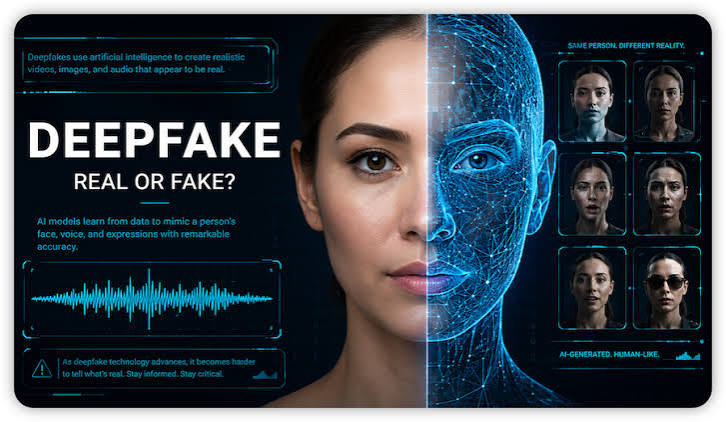
Deepfakes on social media have created a profound crisis of digital trust, transforming the internet from a space of shared information into a landscape of hyper-realistic deception. Driven by breakthroughs in Generative AI and voice synthesis, these synthetic audio-visual forgeries exploit our natural instinct to believe what we see and hear. As a result, users face an environment where distinguishing reality from manipulation is increasingly complex. [1, 2, 3, 4, 5]
The Core Threat Vectors of Deepfakes
                  ┌──────────────────────────────┐
                  │   THE DEEPFAKE THREAT WAVE   │
                  └──────────────┬───────────────┘
                                 │
         ┌───────────────────────┼───────────────────────┐
         ▼                       ▼                       ▼
┌─────────────────┐     ┌─────────────────┐     ┌─────────────────┐
│ Political &     │     │ Identity Theft  │     │ Non-Consensual  │
│ Disinformation  │     │ & Financial     │     │ Harms & Digital │
│ Campaigns       │     │ Scams           │     │ Violence        │
└─────────────────┘     └─────────────────┘     └─────────────────┘
- Political Manipulation and Disinformation: Deepfakes serve as highly effective political weapons, deployed to distort candidate statements, shape false narratives, and deepen societal polarization during sensitive election cycles. [1, 2]
- Advanced Identity Theft and Financial Scams: Threat actors leverage real-time video and voice cloning to bypass security protocols, execute sophisticated social engineering attacks, and impersonate corporate executives or trusted individuals to intercept sensitive information or authorize fraudulent financial transactions. [1, 2, 3]
- Gendered Harms and Digital Violence: A massive portion of malicious deepfakes targeting individuals consists of non-consensual sexual imagery. With modern tools requiring only a single reference photo, private citizens—disproportionately young women—face heightened risks of targeted extortion, public humiliation, and psychological distress. [1, 2, 3]
The Societal Collapse of “Visual Trust”
The widespread circulation of synthetic media causes a unique psychological phenomenon known as epistemic anxiety—a constant state of confusion, doubt, and emotional unease when interacting with digital content. This erodes trust in two distinct waves: [1]
| Impact Metric | Traditional Media Dynamics | The Deepfake “Post-Truth” Era |
|---|---|---|
| Verification Barrier | Content verified through trusted editorial channels. | Platforms struggle with complex forensic authentication challenges. |
| Algorithmic Velocity | News spreads based on human curation and general public interest. | Algorithms optimize for engagement, accelerating emotionally resonant, unverified deepfakes. |
| The “Liar’s Dividend” | Public figures are held accountable to recorded video and audio proof. | Malicious actors can dismiss genuine, incriminating evidence as a “deepfake”. |
| Audience Skepticism | Audiences trust primary visual sources implicitly. | Chronic exposure erodes trust in all media, making even authentic footage highly suspect. |
Community Perspectives
Community experts and researchers highlight how deepfakes are structurally shifting how we internalize information:
“Because they are so realistic, deepfakes can scramble our understanding of truth in multiple ways… as we become more attuned to the existence of deepfakes, there is also a subsequent, corollary effect: they undermine our trust in all videos, includin
Combating the Threat Landscape
Addressing this challenge requires a coordinated approach spanning multiple sectors:
- Legal Protections: Legislative frameworks are actively catching up. For instance, the federal TAKE IT DOWN Act mandates that platforms remove non-consensual intimate deepfakes within 48 hours of reporting. [1]
- Technical Verification: Ongoing development of digital forensics tools aims to tag, watermark, and track the metadata provenance of digital media. [1, 2]
- Individual Epistemic Agency: Educational frameworks must evolve beyond rigid checklists, teaching citizens how to cultivate personal critical-thinking strategies to analyze source credibility independently. [1]
If you are exploring this topic for a project or defense strategy, let me know if you would like to focus on:
- The latest forensic detection tools being used by tech platforms
- A deep dive into global legal regulations or specific state laws
- Strategies for personal digital asset protection and privacy settings
UNESCODeepfakes and the crisis of knowing | UNESCO1 Oct 2025 — Naffi argues that we are facing a crisis of knowing itself, not just a crisis of disinformation. Deepfakes are digital forgeries t…
Instagram·Rebecca JarvisWith deepfakes becoming so believable, how can we tell what’s …15 Jul 2026 — because as scary as AI is now our current technology is going to look prehistoric. in a few years time and with the advancement of…
1:27
Springer Nature LinkThe potential effects of deepfakes on news media and entertainment | AI & SOCIETY | Springer Nature Link23 Oct 2024 — Deepfakes are synthetic media created using generative artificial intelligence (GenAI) tools. They can be used for a variety of pu…
Show all
Deepfakes and Social Media: When Reality Becomes Difficult to Trust
Deepfakes are one of the most powerful and controversial applications of Artificial Intelligence (AI). A deepfake is digitally created or manipulated content that makes a person appear to say or do something that never actually happened. It can be a video, image, or audio recording. Artificial intelligence and machine-learning techniques are used to study a person’s face, voice, expressions, and body movements and then create highly realistic fake content.
The rapid growth of social media has made deepfakes more dangerous because information can spread from one person to millions of people within a very short period. Platforms such as Instagram, Facebook, TikTok, YouTube, and X allow users to create, share, and repost content immediately. Because of this, a fake video can become viral before people have enough time to check whether it is genuine.
The biggest concern is that deepfakes can make reality difficult to trust. In the past, people often considered videos and audio recordings as strong evidence of an event. Today, advanced AI can manipulate such content so realistically that ordinary users may not be able to identify the difference between real and fake material.
How Deepfakes Are Created
Deepfake technology uses AI algorithms trained on a large amount of data. For example, if an AI system receives many images and videos of a particular person, it can learn the person’s facial features, expressions, voice patterns, and movements. The system can then use this information to create new content.
One common technique is face swapping, where one person’s face is digitally placed onto another person’s body. Another method is voice cloning, where AI learns someone’s voice and generates new speech that sounds similar to the original person.
As the technology improves, deepfake content can become increasingly realistic. This makes it difficult for viewers to identify manipulation simply by looking at a video or listening to audio.
Deepfakes and Social Media
Social media is a major reason why deepfakes have become a global concern. Social-media platforms are designed to encourage fast sharing and engagement. Content that is surprising, emotional, controversial, or entertaining often receives more attention.
A fake video that shows a famous person making a shocking statement may attract thousands of views in a short time. People may share the content without verifying its source. Once the video is copied and reposted by multiple accounts, it becomes even harder to trace the original source.
This creates a serious misinformation problem. People may accept false information as fact simply because they have seen it many times online.
Examples of Possible Misuse
Deepfakes can be misused in many ways. A fake video can be created to make a politician appear to give a false statement. A celebrity can be shown saying something offensive that they never said. A business leader can appear to give false financial information. A person’s voice can be copied and used to make a fraudulent phone call.
Deepfakes can also be used against ordinary individuals. Someone may create a fake and embarrassing video involving a person and distribute it on social media. Even when the victim proves that the content is fake, removing every copy can be extremely difficult.
Merits of Deepfake Technology
Although deepfakes are often discussed because of their dangers, the underlying technology also has some useful applications when used ethically and responsibly.
1. Entertainment and Film Industry
Deepfake technology can be useful in movies, television, and digital entertainment. Filmmakers can create realistic visual effects, recreate younger versions of characters, or digitally modify scenes. This can create new creative possibilities for storytelling.
2. Education
AI-generated characters and historical figures can be used in educational videos and interactive learning experiences. Students may find lessons more interesting when information is presented through realistic digital characters.
3. Creative Content Creation
Content creators can use AI-generated voices and characters for storytelling, animation, advertising, and social-media content. This can help creators produce ideas that would otherwise require expensive equipment or large production teams.
4. Voice Assistance and Accessibility
AI-generated speech can be helpful in accessibility-related applications. Synthetic voices can be used to produce spoken content and support people who have difficulty communicating naturally.
5. Media and Advertising
Businesses can use AI-generated digital characters in promotional campaigns. When used with transparency and permission, this technology can reduce production costs and allow companies to experiment with different creative concepts.
6. Preservation of Historical Content
AI can also be used to recreate voices or appearances for educational and cultural projects. This may help museums and educational institutions create more engaging presentations about historical figures.
Demerits of Deepfake Technology
Despite these useful applications, deepfakes can cause serious social, ethical, and personal problems when they are misused.
1. Spread of Misinformation
The most important disadvantage is the spread of false information. A realistic fake video can persuade people that something happened even when there is no evidence supporting it.
For example, a fake speech by an important public figure may be shared widely. Some people may believe it immediately because they can see and hear the person in the video.
2. Damage to Reputation
Deepfakes can seriously damage a person’s reputation. Someone may be falsely shown making offensive statements or behaving badly. Even after the content is proven to be fake, some viewers may continue to believe it.
This can affect careers, relationships, businesses, and social standing.
3. Loss of Trust in Real Information
One of the most dangerous effects of deepfakes is the possibility of losing trust in genuine evidence.
When people know that videos and audio can be manipulated, they may start questioning everything they see online. This can create a situation where real evidence is dismissed as fake.
4. Fraud and Financial Scams
Voice cloning and face manipulation can be used for scams. A criminal may imitate the voice of a family member, manager, business owner, or other trusted person and ask someone to transfer money or share confidential information.
This makes online fraud more sophisticated and difficult to recognize.
5. Cyberbullying and Online Harassment
Deepfakes can be used to embarrass, threaten, or harass people. A person can become the target of fake images or videos that are shared publicly without permission.
The emotional and psychological effects on victims can be serious.
6. Political Manipulation
Deepfakes can be especially harmful during political campaigns and elections. False videos involving politicians or political leaders could influence public opinion.
People may make important decisions based on information that is not genuine.
7. Privacy Problems
Creating a deepfake often requires personal photographs, videos, or recordings. If these materials are collected and used without permission, it can become a serious privacy issue.
People may lose control over how their face or voice is used online.
8. Emotional and Psychological Harm
Victims of deepfake abuse may experience fear, embarrassment, anxiety, anger, and loss of confidence. Since social-media content can remain online for a long time, the effects may continue even after the original post is deleted.
Impact on Society
Deepfakes are not only an individual problem. They can affect society as a whole. When large numbers of people are exposed to fake information, public trust can decrease.
People may become confused about which news sources are reliable. Journalists and organizations may have to spend more time verifying videos, audio, and images before publishing them.
This means society needs stronger digital literacy. People should understand that online content can be manipulated and that attractive or shocking content should not automatically be treated as true.
How Can People Protect Themselves?
Users can reduce the risks of deepfakes by developing good digital habits.
Before sharing a suspicious video, users should check who originally posted it, look for the same information from trusted sources, and compare reports from multiple reliable websites.
People should also be careful with emotionally shocking content. False information often spreads because it creates strong emotions such as fear, anger, or excitement.
Social-media platforms also have an important responsibility. They can improve detection systems, add warning labels, provide reporting tools, and take action against harmful manipulated content.
The Future of Deepfakes
Deepfake technology is likely to become more advanced in the future. AI-generated videos and voices may become even more realistic, making detection increasingly difficult.
At the same time, new tools may be developed to identify manipulated content. Governments, technology companies, schools, journalists, and users will all have a role in dealing with this challenge.
The goal should not be to stop AI technology completely. Instead, society needs to encourage responsible and ethical use while preventing harmful manipulation.
Conclusion
Deepfakes are a powerful example of how artificial intelligence can create both opportunities and serious risks. They can be used positively in entertainment, education, accessibility, advertising, and creative industries. However, misuse can lead to misinformation, fraud, cyberbullying, privacy violations, political manipulation, and damage to people’s reputations.
The greatest danger is the loss of trust. When fake videos and audio look completely real, people may struggle to understand what they can believe. Therefore, social-media users need to become more careful and critical when consuming online content.
In the future, technology will continue to improve, but responsible human behaviour will remain equally important. The ability to verify information, question suspicious content, and use AI ethically will be essential in creating a safer digital society.