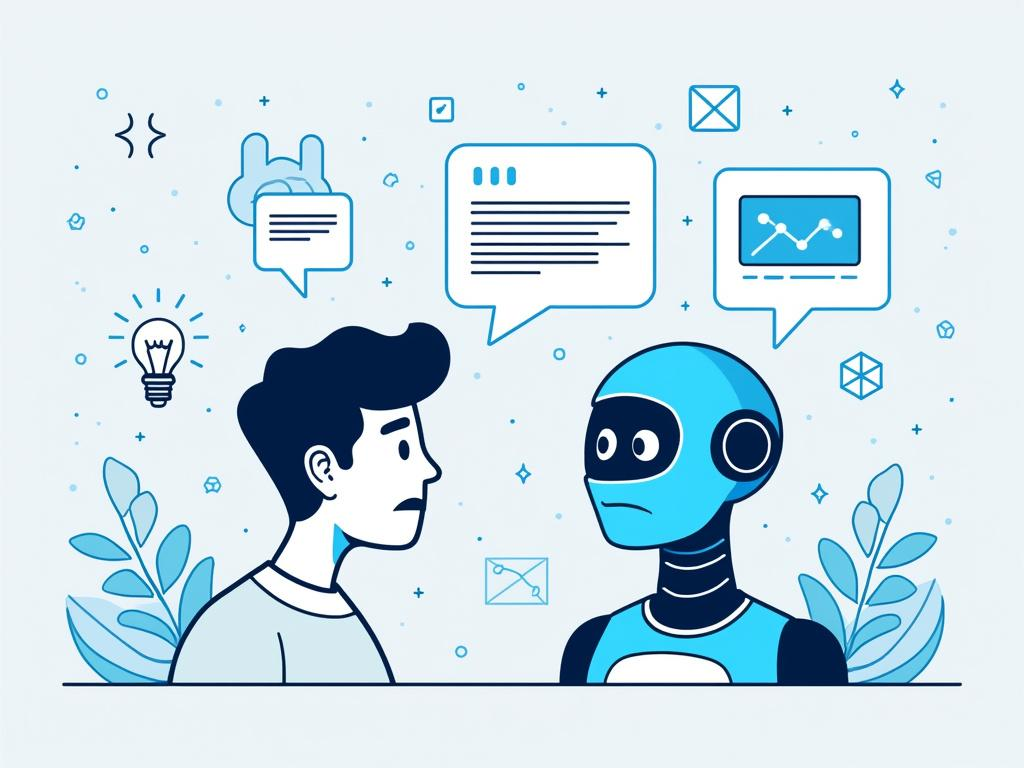
Introduction
Technology has changed the way people communicate. Today, we can send messages instantly, make video calls, communicate through social media, and even talk to artificial intelligence (AI). One of the most popular developments in AI is the chatbot. Chatbots are computer programs designed to communicate with people through text or voice. They are now commonly used in customer service, education, healthcare information systems, shopping websites, banking, and many other areas.
Chatbots can answer questions, provide information, solve simple problems, and communicate with users at any time. They are fast, convenient, and available 24 hours a day. However, as people increasingly communicate with machines, an important question arises: Are we slowly losing genuine human connection?
Human communication is not only about exchanging information. It also involves emotions, facial expressions, body language, empathy, trust, understanding, and personal experiences. While chatbots can imitate human-like conversations, they do not experience emotions in the same way humans do. Therefore, the increasing use of chatbots has both advantages and disadvantages for human relationships.
What Are Chatbots?
A chatbot is an AI-powered system that can communicate with users using natural language. Modern chatbots can understand questions and generate responses that appear conversational.
For example, when a customer visits an online shopping website, a chatbot may answer questions such as:
- “Where is my order?”
- “What is the return policy?”
- “Which product should I buy?”
- “How can I make a payment?”
Instead of waiting for a human employee, the customer can receive an immediate response.
Chatbots have become more advanced because of technologies such as machine learning, natural language processing, and generative AI. Some chatbots can now maintain conversations, explain complicated topics, translate languages, write content, and help people learn.
Advantages of Chatbots
1. Fast Communication
One of the biggest advantages of chatbots is speed. A chatbot can respond within seconds, whereas a human employee may need more time to answer a question.
This is especially useful for businesses where customers need quick support.
2. 24/7 Availability
Humans need rest, but chatbots can operate continuously. A customer can ask a question at midnight or early in the morning and still receive assistance.
This makes chatbots particularly useful for international businesses serving customers in different time zones.
3. Handling Large Numbers of Users
A human customer-service employee can communicate with only a limited number of people at once. A chatbot can interact with thousands of users simultaneously.
This can reduce waiting times and improve customer service.
4. Educational Support
Chatbots can also help students. They can explain lessons, provide examples, answer questions, and help students understand difficult subjects.
Instead of simply giving an answer, an AI tutor can explain a topic step by step.
5. Reduced Workload
Chatbots can handle repetitive tasks, allowing humans to focus on more complicated work. For example, a chatbot can answer frequently asked questions while human employees handle unusual or sensitive customer problems.
Disadvantages of Chatbots
Despite their benefits, chatbots cannot completely replace human communication.
1. Lack of Genuine Emotions
Humans experience emotions such as happiness, sadness, fear, love, anger, and empathy. A chatbot can generate words that sound sympathetic, but it does not experience those emotions like a human does.
For example, if someone says, “I lost someone important to me,” a human friend can understand the emotional situation through personal experience and genuine empathy. A chatbot can respond supportively, but the nature of that connection is different.
2. Loss of Personal Interaction
Face-to-face communication allows people to see facial expressions, gestures, eye contact, and body language. These signals help us understand what another person truly means.
Text-based communication removes many of these important elements.
If people become too dependent on digital communication, they may have fewer opportunities to develop real-world communication skills
3. Emotional Dependence on AI
Some people may begin using chatbots as substitutes for friends or family because chatbots are always available and usually respond without judgment.
Although AI can be useful for conversation, depending on it too heavily may reduce motivation to build and maintain relationships with real people.
4. Misunderstanding
Chatbots can sometimes misunderstand a user’s question or emotional situation. Human communication also involves misunderstandings, but humans can ask follow-up questions and interpret tone, facial expressions, and context more naturally.
5. Privacy Concerns
People may share personal information with chatbots without thinking carefully about privacy. This is particularly important when conversations involve sensitive personal information.
Users should understand how an AI service handles their information before sharing private details.
Human Connection: Why Does It Matter?
Human connection is important for emotional well-being and social development. People need relationships with family, friends, classmates, colleagues, and communities.
A conversation with a human can provide something technology cannot completely reproduce: shared human experience.
For example, when two friends laugh about an old memory, the experience is more than just exchanging words. They share history, emotions, memories, and personal meaning.
Human relationships also teach important skills such as:
- Empathy
- Patience
- Listening
- Cooperation
- Trust
- Emotional understanding
- Conflict resolution
These skills are developed through real interactions with other people.
Chatbots vs Humans
The difference between chatbots and humans can be understood through several points.
| Chatbots | Humans |
|---|---|
| Fast responses | Can take more time |
| Available 24/7 | Need rest |
| Can handle many users | Limited capacity |
| Can process large amounts of information | Use experience and judgment |
| Simulate emotional responses | Experience genuine emotions |
| Do not have personal life experiences | Have memories and experiences |
| Good for repetitive tasks | Better for complex emotional situations |
| Consistent responses | Responses can change with mood and situatons |
Are We Really Losing Human Connection?
The answer depends on how we use technology.
Chatbots themselves are not necessarily responsible for the loss of human connection. The problem begins when technology replaces relationships instead of supporting them.
For example, using a chatbot to get information or solve a simple problem is generally useful. However, if someone chooses an AI chatbot instead of talking to friends, family, teachers, or professionals every time they experience emotional difficulties, human connection may become weaker.
Technology should therefore be treated as a tool, not a replacement for human relationships.
Businesses can use chatbots for routine customer-service questions while allowing human employees to handle complicated or emotional situations. Students can use AI for learning while still interacting with teachers and classmates. People can use AI for information and entertainment while continuing to maintain meaningful relationships in the real world.
The Future of Chatbots and Human Communication
The future will probably not be about humans versus chatbots. Instead, it will be about humans working together with AI.
AI can perform tasks quickly and efficiently, while humans provide creativity, empathy, judgment, emotional intelligence, and personal connection.
The most successful approach is likely to be a balance between technology and human interaction.
We should ask ourselves an important question whenever we use AI:
“Is this technology helping me connect with people, or is it replacing my connection with people?”
If AI is used responsibly, it can make our lives easier without destroying our relationships.
chatbots
Humans need more than information. We need understanding, empathy, trust, shared experiences, and genuine emotional connection. These are the qualities that make human relationships meaningful.
Therefore, we are not necessarily losing human connection because of chatbots—we risk losing it when we allow technology to replace real human interaction.
The future should not be “Chatbots instead of humans.” It should be “Chatbots helping humans.”
Technology should make human life better while preserving the relationships that make life meaningful. The challenge for our generation is not to reject AI, but to use it wisely while remembering the value of a real human conversation.
Technology has become an important part of our everyday lives. Today, people use smartphones, social media, video calls, and artificial intelligence to communicate with others. One of the most interesting developments in technology is the chatbot. Chatbots are computer programs that can communicate with people through text or voice. They are now widely used in customer service, education, shopping, banking, healthcare information, and many other areas.
Chatbots can answer questions, provide information, solve problems, and communicate with users within seconds. They are available 24 hours a day and can communicate with many people at the same time. Because of these advantages, chatbots are becoming increasingly popular.
However, this development also raises an important question: Are we losing real human connection because of chatbots?
Human communication is much more than exchanging information. It includes emotions, empathy, facial expressions, body language, personal experiences, trust, and understanding. Although modern chatbots can communicate in a very human-like way, they do not experience emotions in the same way that humans do. Therefore, chatbots have both advantages and disadvantages when compared with human interaction.
What Are Chatbots?
A chatbot is an artificial intelligence system designed to communicate with people using natural language. Simple chatbots can answer basic questions, while advanced AI chatbots can understand complex questions, generate detailed responses, translate languages, help students learn, and assist with different tasks.
For example, when a customer visits an online shopping website, a chatbot can answer questions such as “Where is my order?”, “How can I return a product?”, or “What payment methods are available?” This allows customers to receive quick support without waiting for a human employee.
Advantages of Chatbots
One of the biggest advantages of chatbots is speed. A chatbot can provide an answer within seconds. This is useful when people need quick information or customer support.
Another major advantage is 24-hour availability. Human employees need breaks and sleep, but chatbots can work continuously. Customers can communicate with them at any time of the day or night.
Chatbots can also communicate with thousands of people simultaneously. A human customer-service worker may only be able to handle a few conversations at once, while a chatbot can respond to many users at the same time. This can reduce waiting times and improve customer service.
Chatbots are also useful in education. Students can ask questions, receive explanations, find examples, and get help with difficult topics. AI can act as a learning assistant and provide support whenever students need it.
Another advantage is that chatbots can reduce repetitive work. Businesses can use chatbots to answer frequently asked questions, allowing human employees to spend more time dealing with complicated problems.
Disadvantages of Chatbots
Despite their advantages, chatbots cannot completely replace human interaction.
The first major disadvantage is the lack of genuine emotions. Humans can experience happiness, sadness, love, fear, excitement, and empathy. A chatbot can produce a response that sounds caring or emotional, but it does not experience those emotions like a human being.
For example, if a person loses someone they love, talking to a close friend can provide genuine emotional support. A chatbot may provide comforting words, but it cannot share the person’s memories, experiences, or emotions.
Another disadvantage is the possible loss of personal interaction. Face-to-face communication allows people to understand facial expressions, eye contact, gestures, and tone of voice. These elements are important for understanding emotions and building relationships.
If people become too dependent on digital communication, they may spend less time interacting with family, friends, classmates, and colleagues. Over time, this could affect their communication and social skills.
Another concern is emotional dependence on AI. Some people may start using chatbots as a replacement for real friends because chatbots are always available and do not judge them. While AI can be useful for conversation and support, it should not completely replace real human relationships.
Privacy is another important issue. People may share personal information with chatbots without considering how that information may be stored or used. Users should therefore be careful about sharing sensitive information with AI systems.
Why Human Connection Is Important
Human connection is essential for emotional and social development. People need relationships with family, friends, teachers, colleagues, and communities.
A conversation between two humans is not only about words. It can include shared memories, emotions, jokes, experiences, and understanding. These things create meaningful relationships.
Human interaction also helps people develop important qualities such as empathy, patience, listening skills, trust, cooperation, and emotional intelligence.
For example, when two friends discuss a difficult problem, they can listen to each other, understand emotions, share personal experiences, and provide support. These experiences help strengthen their relationship.
Chatbots vs Humans
Chatbots and humans have different strengths.
Chatbots are fast, available 24/7, can handle many users, and can process large amounts of information. They are especially useful for repetitive tasks and providing quick information.
Humans, however, are better at understanding emotions, making complex judgments, showing genuine empathy, and building meaningful relationships. Humans can also understand situations through personal experiences and social context.
Therefore, the best solution may not be choosing chatbots instead of humans. Instead, we should use chatbots and humans together.
Are We Really Losing Human Connection?
Chatbots themselves are not necessarily causing people to lose human connection. The problem depends on how people use technology.
Using a chatbot to find information, complete a task, or solve a simple problem can be helpful. However, if people begin replacing family, friends, teachers, or other important relationships with AI, human connection may become weaker.
For example, a student can use AI to understand a difficult lesson but should still communicate with teachers and classmates. A company can use a chatbot to answer simple customer questions while human employees handle emotional or complicated situations.
Technology should therefore be used as a tool that supports human relationships rather than replacing them.
The Future of Human and AI Communication
In the future, chatbots and AI will probably become even more advanced. They may become better at understanding language, emotions, and human behavior. However, human qualities such as genuine love, personal experience, empathy, and meaningful relationships will continue to be important.
The future should not be about “chatbots instead of humans.” It should be about “chatbots helping humans.”
If AI is used responsibly, it can make communication faster and easier while allowing humans to focus on creativity, emotional support, decision-making, and meaningful relationships.
Conclusion
Chatbots are an important development in modern technology. They provide fast communication, 24-hour support, educational assistance, and help businesses serve customers more efficiently. However, they cannot completely replace the emotional depth and authenticity of human relationships.
Humans need more than information. We need understanding, empathy, trust, shared experiences, and genuine emotional connection.
Therefore, we are not necessarily losing human connection because of chatbots. We risk losing it when we allow technology to replace real human interaction.
The right approach is to find a balance. We should enjoy the benefits of artificial intelligence while continuing to value our relationships with real people.
Technology should make our lives better, not make us less human. The challenge is not to reject chatbots, but to use them wisely while protecting the human connections that make our lives meaningful.
Conclusion
Chatbots are one of the most useful developments in modern technology. They provide quick information, 24/7 support, educational assistance, and help businesses communicate with customers efficiently. However, they cannot completely replace the emotional depth and authenticity of human relationships.
Hello http://najiyasherin.online,
I wanted to reach out to see if you’re open to exploring ways to grow your website traffic and boost online performance.
We offer customized SEO services that deliver measurable improvements.
Once you share your target keywords and target market, I’ll send a full proposal.
Best Regards,
Ananya
Hello http://najiyasherin.online,
If you’re looking to boost your website’s visibility, I can help you achieve top Google rankings.
I’ll prepare a complete SEO plan with actionable steps and potential growth insights for your products or services.
Once you share your target keywords and target market, I’ll send a full proposal.
Best Regards,
Ananya