In today’s digital world, social media has become an important part of our everyday lives. Platforms such as Instagram, YouTube, TikTok, and Facebook have changed the way people communicate, advertise, and discover products. Influencer marketing has become one of the most powerful forms of digital marketing. People often follow influencers because they trust their opinions, lifestyles, recommendations, and personal experiences.
However, a new type of influencer is becoming increasingly popular: AI influencers. These are computer-generated or virtual personalities created using artificial intelligence, 3D technology, and digital design. They may have realistic faces, personalities, followers, and even fictional life stories. Some AI influencers post photographs, promote products, collaborate with brands, and communicate with their followers just like human influencers.
This raises an important question: Can artificial people replace real influencers?
What Are AI Influencers?
AI influencers, also known as virtual influencers, are digital characters created using technologies such as artificial intelligence, computer graphics, animation, and 3D modeling. Unlike traditional influencers, they do not have a physical human body or real-life experiences.
They can be designed with a specific appearance, personality, lifestyle, and online identity. Brands can use them to create social media content, advertisements, product promotions, and campaigns.
AI influencers can appear in different locations, wear different clothes, promote different products, and participate in digital events without physically travelling anywhere. Their content can be carefully planned and controlled by the companies or creators behind them.
Why Are AI Influencers Becoming Popular?
One major reason for the growth of AI influencers is the rapid development of artificial intelligence. AI tools can now create highly realistic images, videos, voices, and digital characters.
Another reason is brand control. Human influencers have their own opinions, emotions, personal lives, and unexpected situations. An AI influencer can be completely controlled by the brand or agency managing it.
For example, a company can decide exactly what an AI influencer should wear, say, and promote. There is less risk of the influencer making controversial statements or becoming involved in unexpected personal situations.
AI influencers can also work continuously. They do not need to sleep, travel, or take breaks. This makes them attractive to businesses that want to create content regularly.
Advantages of AI Influencers
1. Complete Creative Control
One of the biggest advantages of AI influencers is that brands have greater control over their appearance and content. Companies can create a particular personality and visual style that matches their brand identity.
For example, a fashion company could create a virtual influencer specifically designed to represent its clothing style.
2. Lower Long-Term Costs
Hiring human influencers can sometimes be expensive, especially when they have millions of followers. AI influencers can potentially reduce some costs related to travel, photoshoots, accommodation, and physical production.
Once a virtual influencer has been created, the same character can be used for many campaigns.
3. Available 24/7
A human influencer cannot create content all day and night. AI influencers, however, can be managed digitally at any time.
They can appear in posts, advertisements, videos, and campaigns whenever required.
4. Global Reach
AI influencers are not limited by physical locations. A virtual personality can appear in New York today, Paris tomorrow, and Tokyo the next day without actually travelling.
This makes them useful for international marketing campaigns.
5. Consistent Brand Image
Human influencers may change their appearance, style, opinions, or personal branding over time. AI influencers can maintain a consistent appearance and personality.
This consistency can be valuable for companies that want a strong and recognizable brand identity.
Disadvantages of AI Influencers
Despite these advantages, AI influencers also have several important disadvantages.
1. Lack of Real Human Connection
The biggest weakness of AI influencers is that they are not real people. They cannot experience genuine emotions, relationships, struggles, or personal experiences.
A human influencer might say, “I used this product and it helped me,” based on their actual experience. An AI influencer cannot genuinely experience the product.
This can make the relationship between AI influencers and their followers feel less authentic.
2. Trust Issues
Influencer marketing works largely because of trust. Followers often believe recommendations from influencers they admire.
With AI influencers, people may question whether the recommendation is genuine or simply created because a company wants to sell something.
If audiences feel that an AI influencer is only a marketing tool, they may become less interested in the content.
3. Ethical Concerns
AI influencers can create questions about transparency and honesty.
If an AI-generated person looks completely real, some users may not immediately realize that the person does not actually exist. This can create confusion.
Therefore, brands should clearly disclose when they are using AI-generated influencers.
4. Unrealistic Beauty Standards
AI influencers can be designed with perfect skin, perfect bodies, perfect faces, and unrealistic lifestyles.
This may create pressure among young social media users who compare themselves with these artificial images.
Real people naturally have imperfections. AI characters can easily be edited to appear “perfect,” which may contribute to unrealistic expectations about beauty and lifestyle.
5. Lack of Genuine Experiences
Real influencers can share stories about their lives, failures, achievements, travel experiences, and relationships. These experiences help audiences connect with them emotionally.
AI influencers cannot create genuine memories because their personalities and stories are digitally constructed.
Can AI Influencers Replace Real Influencers?
The simple answer is probably not completely.
AI influencers may become an important part of influencer marketing, but completely replacing human influencers is difficult.
Human connection is one of the most powerful elements of social media. People follow influencers not only because of their appearance but also because of their personalities, experiences, emotions, and authenticity.
For example, when a real fitness influencer shares their journey of losing weight, overcoming difficulties, and becoming healthier, followers may feel inspired because the story is based on a real human experience.
An AI influencer can create a similar story, but it is ultimately fictional.
However, AI influencers may become particularly useful in certain industries. Fashion, gaming, technology, entertainment, and virtual reality may benefit greatly from them.
AI Influencers vs Real Influencers
| Feature | AI Influencers | Real Influencers |
|---|---|---|
| Human emotions | Artificial | Genuine |
| Brand control | Very high | Limited |
| Authentic experiences | No | Yes |
| Availability | 24/7 | Limited |
| Physical travel | Not required | Required |
| Audience connection | Can be weaker | Usually stronger |
| Content consistency | Very high | Can vary |
| Risk of personal controversy | Lower | Higher |
The Future of Influencer Marketing
The future may not be about AI influencers replacing human influencers. Instead, we may see both working together.
Brands could use human influencers for authenticity and emotional storytelling while using AI influencers for creative campaigns, virtual advertisements, product demonstrations, and digital experiences.
For example, a real celebrity could introduce a product, while an AI character could appear in a futuristic advertisement for the same product.
This combination could create a new form of influencer marketing where human creativity and artificial intelligence work together.
Conclusion
AI influencers are changing the digital marketing industry. They offer brands creativity, consistency, control, and the ability to produce content without many of the limitations faced by human influencers.
However, they also have weaknesses. They cannot experience real emotions, create genuine memories, or provide authentic personal experiences. Trust and human connection remain extremely important in influencer marketing.
Therefore, AI influencers are unlikely to completely replace real influencers. Instead, they are more likely to become another tool within the influencer marketing industry.
The future of social media may belong to a combination of real people and artificial personalities. As AI technology becomes more advanced, the important question may not be whether AI influencers are real, but whether audiences can trust the content they create.
Ultimately, technology can imitate a human face, voice, and personality, but genuine human connection is much harder to replace.
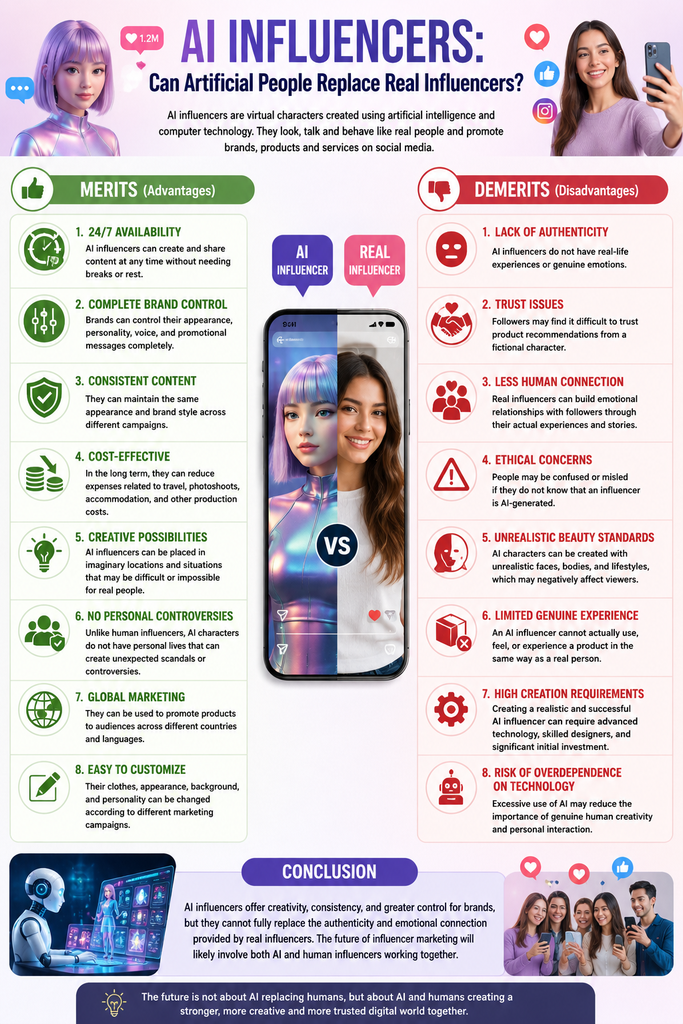
AI Influencers: Can Artificial People Replace Real Influencers? merit and de merit
Sure ❤️ Here are the merits and demerits of AI Influencers in simple points, suitable for your digital marketing assignment/seminar.
AI Influencers – Merits
- 24/7 Availability – AI influencers can create and share content at any time without needing breaks.
- Complete Brand Control – Brands can control their appearance, personality, voice, and promotional messages.
- Consistent Content – They can maintain the same appearance and brand style across different campaigns.
- Cost-Effective – In the long term, they can reduce expenses related to travel, photoshoots, accommodation, and other production costs.
- Creative Possibilities – AI influencers can be placed in imaginary locations and situations that may be difficult or impossible for real people.
- No Personal Controversies – Unlike human influencers, AI characters do not have personal lives that can create unexpected scandals or controversies.
- Global Marketing – They can be used to promote products to audiences across different countries and languages.
- Easy to Customize – Their clothes, appearance, background, and personality can be changed according to different marketing campaigns.
AI Influencers – Demerits
- Lack of Authenticity – AI influencers do not have real-life experiences or genuine emotions.
- Trust Issues – Followers may find it difficult to trust product recommendations from a fictional character.
- Less Human Connection – Real influencers can build emotional relationships with followers through their actual experiences and stories.
- Ethical Concerns – People may be confused or misled if they do not know that an influencer is AI-generated.
- Unrealistic Beauty Standards – AI characters can be created with unrealistic faces, bodies, and lifestyles, which may negatively affect viewers.
- Limited Genuine Experience – An AI influencer cannot actually use, feel, or experience a product in the same way as a real person.
- High Creation Requirements – Creating a realistic and successful AI influencer can require advanced technology, skilled designers, and significant initial investment.
- Risk of Overdependence on Technology – Excessive use of AI may reduce the importance of genuine human creativity and personal interaction
- nrealistic Beauty Standards – AI influencers can have perfect faces, bodies, and skin, which may make people feel insecure about their own appearance. Mental Health Problems – Constant comparison with perfect AI-generated lifestyles may cause stress, low self-esteem, or dissatisfaction. Lack of Real Connection – People may become attached to artificial personalities instead of developing genuine relationships with real people. Misleading Information – AI influencers can promote products or share information that may not be based on real personal experience. Loss of Trust – When people discover that a seemingly real influencer is artificial, they may lose trust in the brand or platform. Job Opportunities for Humans – Increased use of AI influencers could reduce some opportunities for human models, content creators, and influencers. Privacy and Data Concerns – AI-powered platforms may collect information about users to understand their interests and behavior. Too Much Technology Dependence – Excessive interaction with virtual personalities may make people more dependent on technology and less interested in r
Short Conclusion
AI influencers offer creativity, consistency, and greater control for brands, but they cannot fully replace the authenticity and emotional connection provided by real influencers. The future of influencer marketing will likely involve both AI and human influencers working together.
Future of AI Influencers
The future of AI influencers is expected to grow as artificial intelligence becomes more advanced. In the coming years, AI influencers may become more realistic and interactive. They may be able to speak naturally, understand followers’ questions, create personalized content, and communicate with people in real time.
1. More Realistic Virtual Influencers
Future AI influencers may look and behave almost like real humans. Their facial expressions, voices, movements, and personalities will become more realistic. This could make it difficult for people to immediately identify whether an influencer is real or AI-generated.
2. Personalized Content
AI influencers may create different content for different followers. For example, they could recommend fashion products based on someone’s interests or suggest content according to their previous interactions. This could make digital marketing more personalized.
3. AI Influencers in Virtual Reality
AI influencers may become popular in virtual reality (VR) and the metaverse. Users could interact with virtual influencers inside digital environments instead of simply watching their posts on social media.
4. 24/7 Interaction
Unlike human influencers, AI influencers can potentially interact with followers at any time. They could answer comments, respond to messages, and participate in live virtual events continuously.
5. More Use in Digital Marketing
Many brands may use AI influencers for advertising because they provide greater control over content and branding. Fashion, beauty, gaming, tourism, technology, and entertainment companies could especially benefit from virtual influencers.
6. AI + Human Influencers Working Together
The future may not be about AI completely replacing humans. Instead, AI influencers and real influencers may work together. Human influencers can provide emotions, personal experiences, and trust, while AI influencers can provide creativity, consistency, and advanced digital experiences.
7. Greater Need for Transparency
As AI influencers become more realistic, it will become increasingly important for brands to clearly tell audiences when content is AI-generated. Transparency will help maintain trust between brands and consumers.
8. New Career Opportunities
The growth of AI influencers could create new jobs in areas such as AI character design, digital fashion, virtual photography, animation, content creation, and AI marketing.
Conclusion
The future of AI influencers is promising, but they are unlikely to completely replace real influencers. AI can copy appearance, voice, and communication, but genuine human emotions and real-life experiences are difficult to replace.
The most successful future may be a combination of both. Real influencers can provide authenticity and emotional connection, while AI influencers can provide creativity, technology, and unlimited possibilities. This combination could create a new and powerful form of digital marketing.