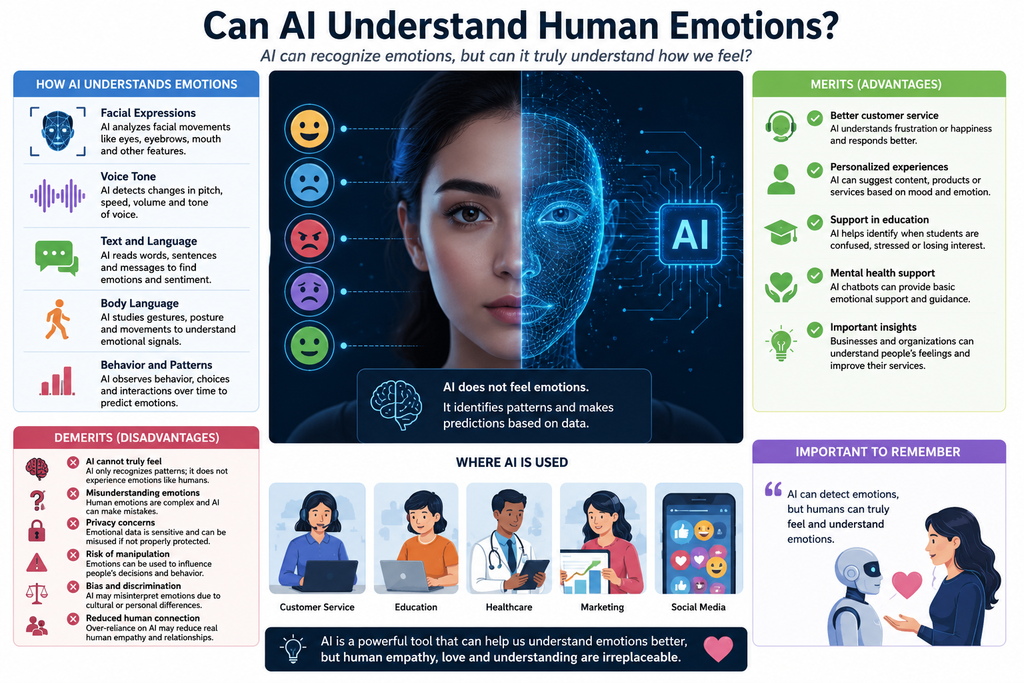
AI cannot truly understand or feel emotions like humans. While it can be programmed to recognize and respond to human emotions based on data, it lacks the biological and psychological capacity for genuine emotional experience. AI can simulate emotional responses, but it doesn’t feel them
I can understand human emotions to some extent by analyzing facial expressions, voice tone, words, messages, and body language. It can identify emotions such as happiness, sadness, anger, fear, and stress. This can be useful in areas like customer service, education, healthcare, and social media.
However, AI does not actually feel emotions like humans. It recognizes patterns from data and makes predictions about how a person may be feeling. Sometimes, it can misunderstand emotions because human feelings are complex and depend on personal experiences and situations.
For example, a person may smile even when they are sad. AI may recognize the smile as happiness and give the wrong interpretation.
Therefore, AI can detect and predict human emotions, but it cannot completely understand or experience emotions like a human being. Human empathy, feelings, and genuine emotional connection are still unique to people.
Can AI Understand Human Emotions?
Artificial Intelligence (AI) has become an important part of modern life. We use AI in smartphones, social media, online shopping, education, healthcare, customer service, and many other areas. One interesting development in AI is its ability to recognize and respond to human emotions. This leads to an important question: Can AI really understand human emotions?
The simple answer is that AI can recognize and analyze signs of emotions, but it cannot experience emotions in the same way humans do. AI uses data, algorithms, and machine learning to identify patterns that may indicate happiness, sadness, anger, fear, stress, excitement, or other emotions.
How Does AI Recognize Human Emotions?
AI can collect information from different sources to identify a person’s possible emotional state. One common method is facial expression analysis. AI systems can analyze a person’s face and look for changes in the eyes, eyebrows, mouth, and other facial features. For example, a smile may be interpreted as happiness, while a frown may be interpreted as sadness or anger.
Another method is voice analysis. AI can study the tone, speed, volume, and pitch of a person’s voice. A person speaking loudly and quickly may be angry or excited, while a slow and quiet voice may indicate sadness or tiredness.
AI can also analyze text and language. This is especially common on social media and in customer service. If someone writes, “I am extremely disappointed with this product,” an AI system can identify the negative sentiment in the sentence.
AI may also consider body language and behavior. Movements, gestures, facial expressions, and patterns of interaction can provide additional information about a person’s possible emotions.
AI and Emotional Intelligence
Humans have emotional intelligence, which means we can recognize emotions, understand feelings, respond with empathy, and consider the situation behind those emotions. AI can imitate some parts of emotional intelligence, but it does not possess human emotional intelligence in the same sense.
For example, if someone tells an AI chatbot that they are having a difficult day, the AI can respond with supportive words. It may say something comforting and appropriate based on patterns it has learned. However, the AI is not actually feeling concern or sympathy. It is generating a response based on information and patterns.
This difference is important. AI can simulate empathy, but it does not experience empathy.
Benefits of AI Understanding Emotions
AI’s ability to recognize emotions can provide many benefits.
1. Better Customer Service
Businesses can use AI to identify whether customers are satisfied, confused, or frustrated. For example, if a customer repeatedly complains about a service, an AI system may recognize the negative sentiment and help direct the customer to appropriate support.
This can make customer service faster and more personalized.
2. Personalized Education
AI can also be useful in education. Learning systems may analyze students’ answers, interactions, and engagement to identify when students are struggling or losing interest.
For example, if a student repeatedly makes mistakes in a particular topic, an AI-powered learning system can provide additional explanations or simpler exercises.
3. Mental and Emotional Support
AI chatbots can provide basic emotional support by listening to users and responding in a calm and supportive way. People may use such systems when they want to talk or organize their thoughts.
However, AI should not be considered a complete replacement for qualified human professionals when someone needs serious emotional or medical support.
4. Improved Human-Computer Interaction
Emotion-aware AI can make technology feel more natural. Instead of simply responding to commands, future AI systems may consider the user’s mood and communication style.
For example, if a person sounds frustrated while using a voice assistant, the system could respond more clearly and patiently.
5. Marketing and Advertising
Companies can analyze customer reviews, comments, and social media posts to understand how people feel about products or brands. This is known as sentiment analysis.
Businesses can use this information to improve products, advertising campaigns, and customer experiences.
Limitations of AI in Understanding Emotions
Although emotion-recognition technology has many advantages, it also has serious limitations.
1. AI Cannot Actually Feel
The biggest limitation is that AI does not have human feelings. It does not experience love, sadness, happiness, jealousy, fear, or excitement.
When AI says, “I understand how you feel,” it does not mean that it has personally experienced the same emotion. It is producing language designed to be appropriate to the situation.
2. Human Emotions Are Complex
Human emotions cannot always be identified from one facial expression or one sentence.
For example, a person may smile when they are nervous. Someone may remain quiet when they are angry. Another person may laugh when they are uncomfortable.
Therefore, AI can sometimes make incorrect conclusions.
3. Cultural Differences
Emotional expressions can vary between cultures and individuals. A facial expression or gesture that means one thing in one cultural context may have a different meaning elsewhere.
If AI is trained mainly using limited or unbalanced data, it may not interpret everyone’s emotions equally accurately.
4. Privacy Concerns
Emotion-recognition technology can involve highly personal information. Facial images, voice recordings, messages, and behavioral data can reveal information about people.
If companies collect or store this information without proper safeguards, it can create privacy risks.
5. Possibility of Manipulation
Emotional data could potentially be used to influence people. For example, if an advertising system knows that a person is feeling anxious or excited, it might try to show advertisements designed to influence that emotional state.
This creates ethical questions about how emotional information should be collected and used.
AI in Social Media
Social media is one of the areas where AI can analyze emotions on a large scale. AI systems can examine posts, comments, reviews, and other forms of text to determine whether the overall sentiment is positive, negative, or neutral.
For example, a company launching a new product may analyze thousands of online comments. AI can quickly identify common opinions and emotional reactions.
However, social media content can be difficult to interpret. Sarcasm, jokes, slang, irony, and cultural expressions can confuse AI systems.
A comment such as “Wow, what a fantastic service!” might actually be sarcastic if the customer had a terrible experience. AI may interpret the sentence as positive even though the person is angry.
The Future of Emotion-Aware AI
In the future, AI may become much better at recognizing emotional signals. Advanced systems may combine facial expressions, voice, text, body language, and context to make more accurate predictions.
AI could potentially be used in smart classrooms, vehicles, customer service systems, games, robots, and other technologies.
For example, a future car might recognize that a driver is tired or stressed and suggest taking a break. A virtual tutor might recognize that a student is confused and explain a lesson differently.
However, the development of emotion-aware AI must be accompanied by privacy protection, ethical rules, transparency, and human supervision.
Conclusion
AI has made significant progress in recognizing and analyzing human emotions. It can examine facial expressions, voice, text, body language, and behavior to predict how someone may be feeling. This technology can improve customer service, education, marketing, accessibility, and human-computer interaction.
However, recognizing an emotion is not the same as truly experiencing or understanding it. Humans have personal experiences, memories, empathy, consciousness, and emotional connections that AI does not possess.
Therefore, AI should be viewed as a tool that can assist humans in understanding emotional signals, rather than as a replacement for genuine human empathy and emotional relationships.
In the future, the goal should not simply be to create AI that can identify emotions. It should be to create AI that uses emotional information responsibly, safely, and respectfully, while keeping human feelings, privacy, and dignity at the center
As artificial intelligence learns to interpret and respond to human emotion, senior leaders should consider how it could change their industries and play a critical role in their firms.
Mar 8, 2019
What did you think of the last commercial you watched? Was it funny? Confusing? Would you buy the product? You might not remember or know for certain how you felt, but increasingly, machines do. New artificial intelligence technologies are learning and recognizing human emotions, and using that knowledge to improve everything from marketing campaigns to health care.AI at WorkResearch and insights powering the intersection of AI and business, delivered monthly.Yes, I’d also like to subscribe to the Thinking Forward newsletterEmail
These technologies are referred to as “emotion AI.” Emotion AI is a subset of artificial intelligence (the broad term for machines replicating the way humans think) that measures, understands, simulates, and reacts to human emotions. It’s also known as affective computing, or artificial emotional intelligence. The field dates back to at least 1995, when MIT Media lab professor Rosalind Picard published “Affective Computing.”
Javier Hernandez, a research scientist with the Affective Computing Group at the MIT Media Lab, explains emotion AI as a tool that allows for a much more natural interaction between humans and machines.“Think of the way you interact with other human beings; you look at their faces, you look at their body, and you change your interaction accordingly,” Hernandez said. “How can [a machine] effectively communicate information if it doesn’t know your emotional state, if it doesn’t know how you’re feeling, it doesn’t know how you’re going to respond to specific content?”
While humans might currently have the upper hand on reading emotions, machines are gaining ground using their own strengths. Machines are very good at analyzing large amounts of data, explained MIT Sloan professor Erik Brynjolfsson. They can listen to voice inflections and start to recognize when those inflections correlate with stress or anger. Machines can analyze images and pick up subtleties in micro-expressions on humans’ faces that might happen even too fast for a person to recognize.
“We have a lot of neurons in our brain for social interactions. We’re born with some of those skills, and then we learn more. It makes sense to use technology to connect to our social brains, not just our analytical brains.” Brynjolfsson said. “Just like we can understand speech and machines can communicate in speech, we also understand and communicate with humor and other kinds of emotions. And machines that can speak that language — the language of emotions — are going to have better, more effective interactions with us. It’s great that we’ve made some progress; it’s just something that wasn’t an option 20 or 30 years ago, and now it’s on the table.”
Which industries are already using emotion AI?
Advertising — In 2009, Rana el Kaliouby, PhD ’06, and Picard founded Affectiva, an emotion AI company based in Boston, which specializes in automotive AI and advertising research — the latter for 25 percent of the Fortune 500 companies.
“Our technology captures these visceral, subconscious reactions, which we have found correlates very strongly with actual consumer behavior, like sharing the ad or actually buying the product,” el Kaliouby said.
In the case of advertising research, once a client has been vetted and agreed to the terms of Affectiva’s use (like promising not to exploit the technology for surveillance or lie detection) the client is given access to Affectiva’s technology. With a customer’s consent, the technology uses the person’s phone or laptop camera to capture their reactions while watching a particular advertisement.
Self-reporting — like feedback during a test group — is helpful, el Kaliouby said, but getting a moment by moment response allows marketers to really tell if a particular ad resonated with people or was offensive, or if it was confusing or struck a heartstring.
Call centers — Technology from Cogito, a company co-founded in 2007 by MIT Sloan alumni, helps call center agents identify the moods of customers on the phone and adjust how they handle the conversation in real time. Cogito’s voice-analytics software is based on years of human behavior research to identify voice patterns.
Mental health — In December 2018 Cogito launched a spinoff called CompanionMx, and an accompanying mental health monitoring app. The Companion app listens to someone speaking into their phone, and analyzes the speaker’s voice and phone use for signs of anxiety and mood changes.
The app improves users’ self-awareness, and can increase coping skills including steps for stress reduction. The company has worked with the Department of Veterans Affairs, the Massachusetts General Hospital, and Brigham & Women’s Hospital in Boston.
Another emotion AI-driven technology for mental health is a wearable device developed at the MIT Media Lab that monitors a person’s heartbeat to tell whether they are experiencing something like stress, pain, or frustration. The monitor then releases a scent to help the wearer adjust to the negative emotion they’re having at that moment.
The BioEssence wearable detects stress or pain and releases a scent to help the wearer adjust to the negative emotion.
Media Lab researchers also built an algorithm using phone data and a wearable device, that predicts varying degrees of depression.
Automotive — Hernandez, the Media Lab researcher, is currently working on a team putting emotion AI into vehicles.
While much attention has been paid to safety in the environment outside of a car, inside there a range of distractions that can impact safety. Consider a car that could tell if a driver was arguing with the passenger next to them, based on elevated blood pressure, and adjust the speed of the distracted operator. Or a sensor that signaled the steering wheel to subtly maneuver the car into the middle of the lane, after a sleep-deprived driver unknowingly is listing to the curb.
Affectiva has a similar automotive AI service of its own, which monitors a driver’s state and occupants’ experiences to improve road safety and the occupant experience.
Assistive services — Some people with autism find it challenging to communicate emotionally. That’s where emotion AI can be a sort of “assistive technology,” Hernandez said. Wearable monitors can pick up on subtleties in facial expressions or body language in someone with autism (like an elevated pulse rate) that others might not be able to see.
Hernandez said there are also “communicative prostheses” that help autistic people learn how to read other’s facial expressions. One example is a game in which the person uses the camera on a tablet to identify “smiley” or “frowny” faces on the people around them.
“That is a way for them to engage with other people and also learn how facial expressions work,” Hernandez said, adding that this video technology that measures moods in “smiley” or “frowny” faces could work for customer feedback in crowded theme parks or hospital waiting rooms, or could be used to provide anonymous feedback to upper management in a large office.
Is emotion AI something to welcome or to worry about?
Hernandez recommended any business interested in applying this technology needs to promote a healthy discussion — one that includes its benefits and what is possible with the technology, and how to use it in private ways.
“What I tell companies is think about what aspects of emotional intelligence should play a critical role in your business,” Hernandez said. “If you were to have that emotional interaction, how would that change, can you use technology for that?”
El Kaliouby said she sees potential in expanding the technology to new use cases, for example, using the call center technology to understand the emotional well-being of employees, or for other mental health uses. But concern over coming off as Big Brother is a legitimate worry, and one that will have to be continuously addressed within the scope of privacy and this technology. To that point, el Kaliouby said that Affectiva requires opt-in and consent for all use cases of its technology.
Another thing to keep in mind is that the technology is only as good as its programmer.
Brynjolfsson warned as these technologies are rolled out, they need to be appropriate for all people, not just sensitive to the subset of the population used for training.
“For instance, recognizing emotions in an African American face sometimes can be difficult for a machine that’s trained on Caucasian faces,” Brynjolfsson said. “And some of the gestures or voice inflections in one culture may mean something very different in a different culture.”
Overall, what’s important to remember is that when it’s used thoughtfully, the ultimate benefits of the technology can and should be greater than the cost, Brynjolfsson said, a sentiment echoed by el Kaliouby, who said it is possible to integrate the technology in a thoughtful way.“The paradigm is not human versus machine — it’s really machine augmenting human,” she said. “It’s human plus machine.