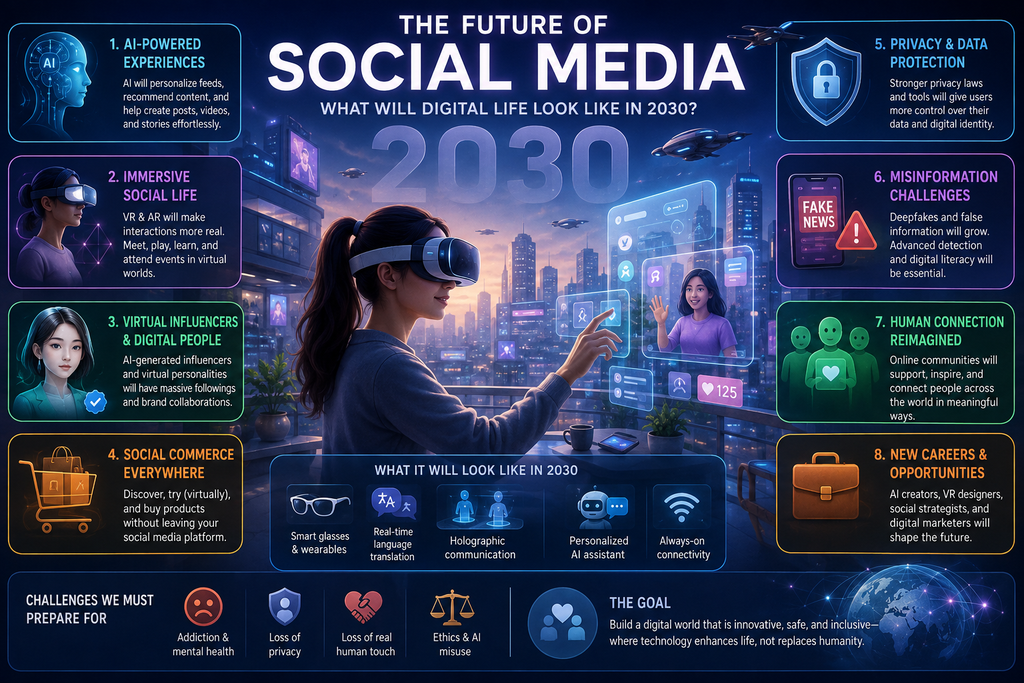
Social media has become one of the most important parts of modern digital life. Platforms such as Instagram, Facebook, YouTube, TikTok, Snapchat, and X have changed the way people communicate, learn, work, shop, and entertain themselves. Today, people can share photos, videos, opinions, and experiences with millions of others within seconds. However, technology is developing very quickly, and social media in 2030 may look very different from what we experience today.
By 2030, social media is likely to become more intelligent, personalized, immersive, and connected with everyday life. Artificial intelligence (AI), virtual reality (VR), augmented reality (AR), wearable devices, and advanced algorithms may completely change how people interact online. At the same time, these developments may create challenges related to privacy, misinformation, addiction, and human relationships.
1. Artificial Intelligence Will Become a Major Part of Social Media
Artificial intelligence is expected to play a much bigger role in social media by 2030. AI will help platforms understand what users like, watch, search for, and interact with. Based on this information, platforms may automatically recommend content that matches individual interests.
For example, instead of manually searching for videos, users may simply tell an AI assistant what they want to see. The AI could create a personalized feed containing news, entertainment, educational content, and advertisements.
AI may also help users create content. A person could provide a simple idea, and AI could generate a video, write a caption, edit photographs, add music, or create animations. This will make content creation easier even for people who do not have professional editing skills.
2. Social Media May Become More Immersive
By 2030, social media may move beyond smartphones and computer screens. Virtual reality and augmented reality could create more immersive online experiences.
Instead of simply sending a message to a friend, people might enter a virtual environment and communicate through realistic digital avatars. Friends living in different countries could meet in a virtual café, attend a concert together, or watch a movie as if they were in the same place.
Augmented reality could also become part of everyday life. People may use smart glasses or other wearable devices to see digital information placed over the real world. For example, while walking through a city, users could see restaurant information, directions, reviews, or advertisements directly in their field of vision.
3. Digital Influencers and Virtual People
The rise of AI-generated influencers is another important possibility for 2030. Today, virtual influencers already exist, but their presence could become much larger in the future.
AI-generated personalities may have their own social media accounts, personalities, voices, and followers. Some companies may use virtual influencers to promote products because they can work continuously and be controlled according to a brand’s requirements.
However, this could create questions about authenticity. Users may find it difficult to know whether they are following a real person or an AI-generated personality. Therefore, social media platforms may need clearer labels for AI-generated content.
4. More Personalized Digital Experiences
Social media in 2030 could become extremely personalized. AI algorithms may understand a person’s interests and preferences in greater detail.
For example, two people using the same platform may see completely different home pages. One person might receive educational videos, while another receives sports, fashion, music, or business content.
Personalization can make social media more useful because users can find relevant information quickly. However, there is also a danger that people may only see content that agrees with their existing opinions. This could create “digital bubbles” where users rarely encounter different viewpoints.
5. Social Commerce Will Grow
Social media and online shopping are likely to become even more connected by 2030. Users may be able to discover a product, learn about it, watch a review, and purchase it without leaving a social media platform.
For example, someone watching a fashion video might be able to virtually try on the clothes using AR and purchase them immediately. Influencers and creators may also have a greater role in product recommendations.
Businesses will increasingly use social media not only for advertising but also as complete shopping platforms. This will create new opportunities for digital marketers, content creators, and small businesses.
6. Privacy and Data Protection Will Become More Important
One of the biggest concerns about the future of social media is privacy. Social media platforms collect large amounts of information about users, including their interests, location, searches, interactions, and online behavior.
By 2030, people may become more aware of how their personal information is collected and used. Governments and technology companies may introduce stronger privacy rules and tools that allow users to control their data.
Users may also expect greater transparency from social media companies. People will want to know why certain content or advertisements are being shown to them and how AI systems make decisions.
7. Misinformation and Deepfakes Will Be a Major Challenge
Technology will make it easier to create realistic images, videos, and voices. While this can be useful for entertainment and education, it can also make misinformation more dangerous.
By 2030, deepfake videos may become extremely difficult to distinguish from real videos. Someone’s face or voice could potentially be recreated using AI. This could be used to spread false information, damage reputations, or manipulate public opinion.
Because of this, social media platforms may need advanced systems to identify AI-generated or manipulated content. Digital literacy will also become extremely important. People will need to check information carefully before believing or sharing it.
8. Human Connection May Change
Social media can help people stay connected regardless of distance, but increased digital interaction may also affect real-world relationships.
If people spend too much time communicating through screens, they may have fewer face-to-face interactions. This could lead to loneliness or weaker personal connections for some people.
On the positive side, social media can help people find communities with similar interests and experiences. People who feel isolated in their local environment may find friendship and support online.
Therefore, the challenge in 2030 will be finding a healthy balance between digital and real-world relationships.
9. New Careers and Opportunities
The future of social media will also create new career opportunities. Digital marketers, AI content creators, virtual influencers, social media managers, AR/VR designers, data analysts, and content strategists may become increasingly important.
Businesses will need professionals who understand both technology and human behavior. People with digital marketing skills will be able to use AI tools to create campaigns, analyze audiences, and communicate with customers more effectively.
Conclusion
The future of social media in 2030 is likely to be more intelligent, immersive, personalized, and connected than today’s digital world. AI may become a daily part of content creation and communication, while AR and VR could make online interaction feel more realistic. Social commerce may transform online shopping, and virtual influencers could become common.
At the same time, serious challenges such as privacy concerns, misinformation, deepfakes, addiction, and loss of genuine human connection cannot be ignored. Technology itself is neither completely good nor completely bad. Its impact depends on how people, businesses, and governments choose to use it.
Ultimately, digital life in 2030 may not simply mean spending more time on social media. Instead, social media could become integrated into everyday life so deeply that the difference between the online world and the real world becomes much smaller. The future will depend on creating a digital environment that is innovative and convenient while still protecting human connection, privacy, trust, and freedom.
he Future of Social Media: What Will Digital Life Look Like in 2030?
By 2030, social media will no longer be a series of isolated apps on our smartphones. Instead, it will mature into an ambient, immersive, and highly intelligent digital layer woven seamlessly into our physical reality. The era of mindless scrolling through two-dimensional feeds is drawing to a close. In its place, the next decade is ushering in a paradigm shift defined by spatial computing, artificial intelligence, hyper-niche communities, and a fundamental rewiring of digital ownership.
Here is how our digital lives will transform by the year 2030.
1. From Flat Feeds to Spatial Realities
The most visible transformation of social media will be the shift from 2D screens to 3D spatial environments. Driven by advancements in lightweight Augmented Reality (AR) glasses and Virtual Reality (VR) headsets, social interaction will become experiential.
- Co-Presence over Connectivity: Rather than liking a friend’s vacation photo, you will step into a high-fidelity, 3D holographic reconstruction of their experience.
- Shared Spaces: Physical distance will become irrelevant for socializing. Friends separated by oceans will gather in virtual living rooms, attend immersive digital concerts, or sit next to each other as avatars in simulated workspaces.
- Persistent AR Overlays: Walking down a physical street, your AR glasses will display digital annotations left by friends—a recommended dish floating outside a restaurant or a virtual piece of art anchored to a public wall.
2. The AI-Synthesized Social Ecosystem
Artificial Intelligence will evolve from an behind-the-scenes recommendation engine into the very fabric of social interaction. By 2030, the line between human and synthetically generated content will blur entirely.
- Hyper-Personalized Algorithms: Algorithms will no longer just curate existing content; they will synthesize custom media in real time based on your mood, biometric feedback, and psychological profile.
- AI Companions and Agents: Social networks will be populated by advanced AI autonomous agents. Humans will interact with AI companions that possess deep contextual memory, emotional intelligence, and distinct personalities.
- Autonomous Digital Twins: You will deploy your own AI “digital twin” to manage your online presence. This avatar will scan networks, filter relevant information, RSVP to digital events, and even network with other digital twins to find collaborative opportunities while you sleep.
[2026: Content Curation] ➔ Algorithms sort user-generated posts.
[2030: Content Synthesis] ➔ AI generates customized immersive media in real time.
3. The Fragmentation of Mega-Platforms
The era of the “digital town square”—where billions of people occupy a handful of massive, centralized networks—is splintering. Digital fatigue, censorship concerns, and the desire for authentic human connection are driving users toward fragmented ecosystems.
- Micro-Communities and Digital Tribes: Social life will revolve around highly specialized, invite-only micro-networks dedicated to hyper-specific subcultures, professions, or values.
- Interoperable Ecosystems: Driven by decentralized protocols, social networks will become interoperable. Users will own their social graph (their network of friends and data), allowing them to move seamlessly between different apps and platforms without losing their followers or digital identity.
- The Rise of “Anti-Algorithms”: Premium networks will emerge that deliberately ban algorithmic feeds, deepfakes, and ad-driven models, charging subscription fees to guarantee raw, unmanipulated human interaction.
4. Decentralization and the Ownership Economy
The business model of social media will undergo a severe reckoning. The traditional structure—where centralized corporations monetize user data in exchange for a free service—will be heavily challenged by Web3 architecture and decentralized autonomous organizations (DAOs).
| Metric / Feature | Era of Big Tech (2010s–2020s) | The Decentralized Era (2030) |
|---|---|---|
| Data Ownership | Corporate servers own and monetize user data. | Users retain absolute ownership via digital sovereign IDs. |
| Monetization | Attention-based advertising models. | Direct micro-transactions, tokenized rewards, and value-creation. |
| Governance | Unilateral corporate policy decisions. | Community-driven voting and open-source protocols. |
Users will treat their digital profiles as valuable financial portfolios. Content creators will interact directly with their audiences through tokenized economies, eliminating corporate middlemen and establishing true digital scarcity for virtual goods, art, and experiences.
5. Mental Well-being, Cognitive Liberty, and Biometric Privacy
As digital networks integrate more deeply with our biological selves, the conversation around social media will pivot sharply toward mental health protection and cognitive liberty.
- Biometric Feedbacks: Devices will monitor heart rates, eye movements, and neural signals to optimize user experience. While this creates frictionless interfaces, it introduces unprecedented privacy risks.
- The “Right to Disconnect”: With social media embedded in AR glasses and smart environments, escaping the digital world will require conscious effort. “Digital detoxing” will transform from a luxury trend into a critical mental health necessity, supported by strict legal frameworks protecting a citizen’s right to offline privacy.
- Synthetic Guardrails: To combat the epidemic of digital isolation, platforms will incorporate built-in psychological guardrails. Algorithms will be legally mandated to prioritize long-term cognitive well-being over short-term dopamine engagement.
6. The Synthesis of Work and Play
By 2030, the strict boundary between professional networking (like LinkedIn) and casual socializing (like Instagram) will dissolve. Digital life will reflect a unified, fluid reality where economic production and social leisure coexist.
Gamified social spaces will double as economic marketplaces. A teenager in 2030 might earn a living by designing digital fashion assets for avatars, hosting virtual events, or managing algorithmic moderation tools within a localized metaverse community. The digital economy will fully mature, making “digital citizen” a primary socio-economic identifier.
Conclusion: A New Dawn for Human Connection
Digital life in 2030 will be radically more immersive, intelligent, and personalized than it is today. While the risks of deepfakes, cognitive manipulation, and algorithmic isolation are profound, the potential for building global, empathetic, and highly collaborative human networks is equally vast.
Ultimately, social media will stop being a destination we visit through a glass screen. It will become the invisible, oxygen-like infrastructure that connects human consciousness across the physical and digital divide.
To explore how these changes might impact your specific industry or lifestyle, let me know:
- What specific sector (e.g., education, marketing, entertainment, mental health) you are most focused on?
- Whether you want to focus on the technological challenges or the ethical implications of this evolution?
I can provide a highly targeted breakdown or generate a speculative case study based on your preferences.
Merits of Social Media in 2030
- Better Communication – AI, VR, and holographic technology may make communication faster and more realistic, even when people live far apart.
- Personalized Experience – AI can provide users with content based on their interests, making social media more useful and relevant.
- Easy Content Creation – AI tools can help people create videos, images, captions, and advertisements without needing advanced technical skills.
- More Business Opportunities – Social commerce can help businesses reach customers directly through social media and increase online sales.
- Better Education – Students may use VR, AI tutors, and interactive social platforms to learn in more interesting and engaging ways.
- New Career Opportunities – Digital marketing, AI content creation, virtual influencers, VR design, and social media management may create new jobs.
- Global Connectivity – People from different countries and cultures can communicate, collaborate, and build communities more easily.
Demerits of Social Media in 2030
- Privacy Problems – Increased data collection may expose personal information and make it difficult for users to maintain privacy.
- AI-Generated Fake Content – Deepfakes and AI-generated news may make it difficult to identify what is real and what is fake.
- Social Media Addiction – Highly personalized platforms may encourage people to spend too much time online.
- Loss of Human Connection – Excessive digital communication may reduce face-to-face conversations and genuine human interaction.
- Job Displacement – AI and virtual technologies may replace some traditional jobs, especially repetitive digital tasks.
- Mental Health Concerns – Constant comparison, social pressure, likes, followers, and unrealistic AI-generated content may negatively affect people’s well-being.
- Digital Divide – Advanced technologies may not be equally available to everyone, creating a gap between people who have access to technology and those who do not.
Conclusion
The future of social media in 2030 will bring many benefits as well as serious challenges. AI, VR, AR, and other technologies can make digital life easier, faster, and more creative. However, privacy, misinformation, addiction, and loss of human connection must be carefully managed. The goal should be to use technology to enhance human life rather than replace human relationships.
Available next action: Create a downloadable DOCX file here in this chat containing the editable prose above