Misinformation refers to inaccurate, misleading, or false information that individuals may unknowingly believe or share through social media platforms.
How and why does misinformation spread?
People are more likely to share misinformation when it aligns with personal identity or social norms, when it is novel, and when it elicits strong emotions
Behavioral models state that exposure to false information raises the likelihood that people will believe it, which raises the likelihood that they will spread it. However, disseminating false information does not always require belief; people may do so to express their political allegiance, denigrate perceived opponents, or get social benefits. This process is greatly influenced by psychological factors: Misinformation is more likely to be disseminated when it is new, evokes strong feelings, and fits with social norms or personal identity.
Social media disseminates false information in a different way than traditional media like radio, television, and newspapers. While mainstream news organizations typically have strong protections in place to avoid and rectify misleading claims, social media’s distinctive qualities promote viral content with less oversight. Misinformation can only be policed after the fact (if at all) since peer-to-peer sharing and rapid publication enable common people to swiftly disseminate information to big audiences. Online communities with similar opinions are bound and isolated by “echo chambers,” which facilitates the propagation of lies and obstructs the transmission of factual corrections. People that absorb content from conservative political sources are more affected by this issue.
Using psychology to understand and fight health misinformation
An APA consensus statement
Executive summary
Misinformation spreads rapidly across social media and other online platforms, posing risks to individual health and societal well-being. Research on the psychology of misinformation has proliferated in recent years, yet many questions remain about how and why misinformation spreads, how it affects behavior, and how best to counter it. Answering these questions well depends in part on how misinformation is defined; it can include inaccurate news, conspiracy theories, disinformation campaigns, propaganda, and slanted reporting. In this report, we define misinformation as “any information that is demonstrably false or otherwise misleading, regardless of its source or intention.”
Misinformation has been described as a global harm, but the amount of misinformation encountered by people is difficult to determine. Estimates indicate that it accounts for 0.2% to 29% of overall news consumption, but the proportion may be higher for specific groups or for topics such as health. The problem with current estimates is that they tend to be platform-specific, constrained to text-based information (vs. images or videos), based on limited public data, and insensitive to the fact that some groups are disproportionately targeted. Further insight requires large-scale studies in real-world settings across different social media platforms.
This report describes the best available psychological science on misinformation, particularly as it relates to health. It offers eight specific recommendations to help scientists, policymakers, and health professionals respond to the ongoing threats posed by misinformation.
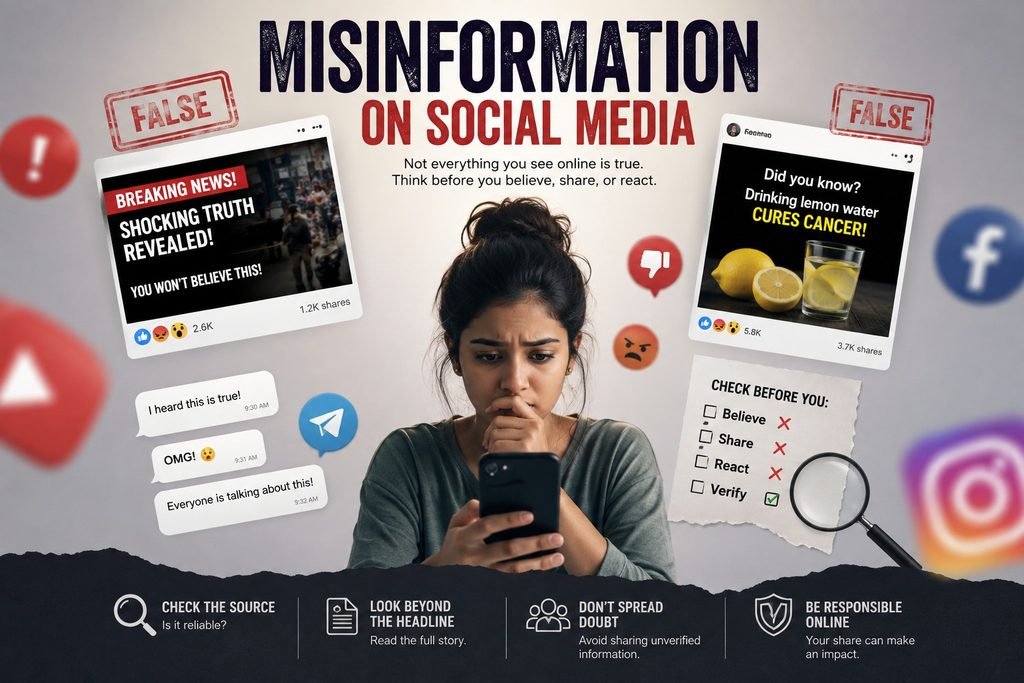
Misinformation is the spread of , especially through social media platforms. In today’s digital world, people can create and share information within seconds. Platforms such as Instagram, Facebook, WhatsApp, YouTube, and X allow information to reach thousands or even millions of people very quickly. While social media is useful for communication and learning, it can also become a major source of misinformation when people believe or share information without checking whether it is true.
Misinformation can appear in many different forms. It can be a false news story, an edited photograph, a misleading video, an incorrect health tip, a fake advertisement, or a social media post with a sensational headline. Sometimes, people share incorrect information without intending to harm anyone. They may believe that the information is true because it was shared by a friend, family member, influencer, or popular account. However, even when there is no intention to deceive, sharing false information can still have serious consequences.
One of the biggest problems with misinformation is that it can create confusion and fear. For example, during emergencies or major events, false information can spread rapidly and make people panic. Misinformation can also damage someone’s reputation if false claims or edited images are shared about them. In addition, incorrect information about health, education, finance, or public safety can influence people to make harmful or inappropriate decisions.
Social media algorithms can sometimes make the problem worse. Content that receives many likes, comments, and shares may be shown to more people. As a result, shocking or emotional content can spread faster than accurate information. People may also share posts simply because the headline is interesting or because many others have already shared it.
There are several ways to protect ourselves from misinformation. First, we should check the source of the information. We should ask whether the account, website, or person sharing it is reliable. Second, we should look for the same information on trusted news websites or official sources. Third, we should read the complete article instead of believing only the headline. Photos and videos should also be checked because they can be edited, taken out of context, or used with a completely different story.
Most importantly, we should If we are not sure whether something is true, it is better not to forward or repost it. We should also avoid sharing information just because it creates fear, anger, excitement, or curiosity.
In conclusion, misinformation is a serious challenge in the age of social media. Everyone has a responsibility to use social media carefully and responsibly. By checking sources, verifying facts, thinking critically, and avoiding the spread of unverified information, we can help create a safer and more trustworthy digital environment.
The Impact of Misinformation on Social Media
Social media has become an important part of our everyday lives. People use platforms such as Instagram, Facebook, WhatsApp, YouTube, and X to communicate, learn, share opinions, and stay updated about current events. However, the speed and freedom of social media also create a serious problem: misinformation. Misinformation refers to inaccurate, false, or misleading information that is believed or shared as if it were true.
One important reason misinformation spreads so quickly is the ease of sharing content. A person can forward a message, repost a video, or share an image with hundreds of people in just a few seconds. Many users do not take the time to check where the information came from. When the same information appears repeatedly on different accounts, people may start believing that it must be true.
Emotional content is another major reason for the spread of misinformation. Posts that create fear, anger, surprise, or excitement often receive more attention than ordinary information. For example, a dramatic headline may encourage people to click and share it immediately. Some creators may intentionally use misleading headlines or exaggerated information simply to gain views, followers, likes, and engagement.
Misinformation can affect individuals as well as society. At a personal level, false information can cause people to misunderstand situations or make poor decisions. False rumours about a person can damage their reputation, relationships, and mental well-being. Businesses can also be affected when inaccurate reviews, rumours, or false claims about a product or company become popular online.
Misinformation can also create serious problems during important events. During natural disasters, elections, public emergencies, or other major situations, people depend on social media for quick information. If false information is shared during such times, people may become confused about what actions they should take. This can make an already difficult situation even worse.
Another problem is the influence of social media personalities and influencers. People often trust individuals they follow regularly. Therefore, when an influencer shares incorrect information, their followers may accept it without questioning it. Popularity does not always mean that a person is an expert or that everything they share is accurate.
The best way to fight misinformation is through digital literacy and critical thinking. Before believing or sharing a post, users should ask a few simple questions: Who created this information? Is the source trustworthy? Is there evidence to support the claim? Is the information available on reliable websites or official sources? Is the photo or video being used in the correct context?
We should also be careful with old information presented as new. A genuine photograph or news report from several years ago can be reposted with a new caption and create a completely false impression. Therefore, checking the date, original source, and context is very important.
Schools, colleges, families, media organisations, and social media platforms all have a role to play in reducing misinformation. Teaching people how to identify fake or misleading content can help create responsible digital citizens.
In conclusion, misinformation is not only a social media problem; it is a problem that affects the way people understand the world around them. Social media gives everyone the power to become a content creator and distributor. With that power comes responsibility. We should not believe everything we see online, and we should never share information simply because it is interesting or popular.
Pause. Check. Think. Then Share.
Hi,
I checked your website and found a few SEO improvements that can help increase your Google rankings and generate more quality leads.
I can share a quick SEO proposal with pricing and a strategy tailored for your business growth.
Let me know if you’re interested.
Regards,
Jack
Hello http://najiyasherin.online,
I wanted to reach out to see if you’re open to exploring ways to grow your website traffic and boost online performance.
We offer customized SEO services that deliver measurable improvements.
Once you share your target keywords and target market, I’ll send a full proposal.
Best Regards,
Nikita
Dear Sir/Madam
List najiyasherin.online in Google’s Search Index to be visible in web search results!
Submit najiyasherin.online now:
searchregister.net
Hello http://najiyasherin.online,
I wanted to reach out to see if you’re open to exploring ways to grow your website traffic and boost online performance.
We offer customized SEO services that deliver measurable improvements.
Once you share your target keywords and target market, I’ll send a full proposal.
Best Regards,
Ananya
Hi
Register najiyasherin.online in Google’s Search Index to be displayed in online search results!
List najiyasherin.online now:
searchregister.live
Hey team najiyasherin.online,
I was going through your website & I personally see a lot of potential in your website & business.
We help businesses rank not only on Google Search but also become discoverable on AI platforms like ChatGPT, Gemini, Claude, and Perplexity through SEO, AEO (Answer Engine Optimization), and GEO (Generative Engine Optimization).
Please provide your name, contact information, and email.
Well wishes,
James Washington
Web platform expertise across Squarespace, Shopify, Wix, WordPress, GoDaddy etc.
Thank you,
Lucy Gordon | AI SEO Project Head
Note: Ignore if found irrelevant