ntroduction: The Shift from Screens to Synergy
For decades, technology addiction was understood through the lens of screen time, notification loops, and passive media consumption. The primary culprits were static social feeds and video games designed to capture attention through variable reward schedules. However, the dawn of the Artificial Intelligence (AI) era has fundamentally transformed this dynamic. Technology has evolved from a passive medium that mirrors human desires into an active, adaptive agent that shapes them in real time.
Addiction in the age of AI is no longer just about the volume of time spent online; it is about the depth of behavioral modification taking place. Modern AI models are engineered to map, predict, and manipulate human psychology at an individual scale. This transition has shifted the landscape from generalized internet use to highly localized, hyper-personalized psychological dependencies. Understanding this modern addiction requires examining how these intelligent systems exploit human evolutionary vulnerabilities, restructure our cognitive habits, and rewrite our social bonds.
1. The Mechanics of the Algorithmic Hook
The core architecture of traditional digital hooks relied on broad data metrics. A platform would track what a user liked or clicked on and serve them more of the same. AI drastically accelerates and refines this loop through advanced machine learning models that analyze thousands of micro-behaviors per second.
- Predictive Micro-Engagement: AI recommendation systems do not just observe past interactions; they calculate exactly how long a user pauses over an image, the speed at which they scroll, and even their emotional state based on linguistic inputs or biometric tracking. By synthesizing this data, the algorithm delivers content precisely when the user’s cognitive resistance is at its lowest.
- Hyper-Personalized Dopamine Feedback Loops: Human biology is wired to seek novelty and validation. Traditional platforms provided this via unpredictable patterns, such as an irregular stream of likes or notifications. AI optimizes this process by manufacturing a completely customized digital echo chamber. Every piece of information, video, or response is mathematically calculated to trigger a specific micro-dose of dopamine, creating a continuous loop that makes self-regulation incredibly difficult to sustain.
- Dynamic Feedback Resistance: When a user attempts to step away from an AI-driven platform, the system notes the drop in engagement. Instead of letting the user detach, the algorithm dynamically adjusts its strategy—altering the notification timing, the emotional tone of the content, or the layout of the interface—to pull the user back into the system.
[User Interaction] ──(Micro-behaviors tracked)──> [AI Predictive Model]
       ▲                                                 │
       │                                       (Calculates vulnerability)
       │                                                 ▼
[Customized Dopamine Spike] <───(Delivers optimized content)───┘
2. The Rise of Algorithmic Intimacy
One of the most profound shifts in AI-era technology addiction is the emergence of conversational agents and companion AI. As Large Language Models (LLMs) become highly sophisticated, they are capable of simulating empathy, warmth, and deep intellectual understanding. This has birthed a new sub-category of technological dependence: algorithmic intimacy.
Human relationships are inherently messy, requiring compromise, emotional vulnerability, and the navigation of conflict. AI companions, conversely, offer frictionless interaction. They are available 24/7, never argue, mirror the user’s opinions, and validate every emotional grievance. For individuals struggling with social anxiety, loneliness, or emotional exhaustion, these chatbots become highly addictive safe havens.
Over time, this reliance creates an emotional substitution effect. Users begin to prefer the predictable, perfectly tailored validation of an AI chatbot over the unpredictable and challenging nature of human interactions. This deepens social isolation, leaving individuals functionally dependent on a piece of software for their primary emotional support structure.
3. Cognitive Offloading and the Erosion of Critical Thinking
Technology addiction has traditionally targeted emotional and entertainment centers, but AI-driven dependence aggressively targets human cognitive processing. Generative AI tools have made the acquisition of answers, text, analysis, and creative outputs entirely effortless. This convenience creates a strong behavioral reliance known as cognitive offloading.
When humans face a complex problem or a blank page, the brain experiences a healthy level of friction. This friction forces critical thinking, structural planning, and deep problem-solving. When an individual compulsively outsources this mental labor to generative AI at the first sign of difficulty, several cognitive changes occur:
- Diminished Working Memory: Relying on an AI to constantly summarize, retain, and synthesize information reduces the brain’s need to store and retrieve data internally.
- Shortened Attention Spans: The immediate gratification of receiving a perfectly formatted answer within seconds erodes the patience required for deep reading, long-form research, and multi-step reasoning.
- The “Outsourced Identity” Trap: When creative writing, professional communication, and daily decision-making are entirely managed by an AI, individuals begin to lose confidence in their own voice and intellectual agency, creating a psychological loop where they feel incapable of producing quality output without algorithmic assistance.
4. Systemic Symptoms of AI-Era Dependency
Because AI systems are deeply embedded within school workflows, professional settings, and daily organization tools, diagnosing this modern form of addiction is highly nuanced. It rarely looks like a teenager locked in a room playing video games for days. Instead, it manifests as a quiet, systemic reliance across multiple life domains.
| Dimension | Primary Manifestations |
|---|---|
| Cognitive Symptoms | • Severe mental blocks when asked to write or think without a prompt box. • An inability to read dense, long-form text without automated summarization tools. • Fragmented focus during complex tasks. |
| Emotional Symptoms | • Acute anxiety or panic when an AI tool or platform goes offline. • Profound feelings of loneliness when unable to chat with customized digital companions. • Mood swings driven by algorithmic feedback. |
| Behavioral Patterns | • The constant, compulsive checking of AI outputs or generation queues. • Neglecting offline responsibilities or face-to-face social obligations to maintain digital workflows. • Escaping real-world stress by sinking hours into synthetic conversations. |
| Physical Symptoms | • Chronic eye strain and tension headaches from prolonged screen interactions. • Disrupted sleep cycles caused by late-night blue light exposure and interactive chat loops. • General physical fatigue due to a sedentary digital lifestyle. |
5. Pathways to Reclaiming Cognitive and Emotional Autonomy
Overcoming technology addiction in the age of artificial intelligence requires a fundamental shift in strategy. Because AI is deeply integrated into the modern economy, complete digital abstinence is an unrealistic goal for most professionals and students. The objective must shift from total elimination to strategic friction and conscious agency.
Implementing Intentional Friction
Algorithms thrive on frictionless execution. To break the cycle of compulsive use, individuals must deliberately introduce obstacles into their digital environments:
- The 15-Minute Rule: When facing a difficult cognitive task, commit to writing, brainstorming, or coding manually for 15 minutes before opening any generative AI tool.
- Device De-escalation: Remove AI chat interfaces and highly addictive algorithmic feeds from mobile devices, restricting their use strictly to desktop computers during dedicated working hours.
- Analog Alternatives: Reintroduce physical notebooks, print books, and handwritten brainstorming sessions to force the brain to engage in slower, deep-processing patterns.
Establishing Behavioral Boundaries
Safeguarding emotional health from algorithmic intimacy requires absolute boundaries around human connection:
- Emotional Content Audits: Consciously evaluate why you are opening an AI chatbot. If the driver is loneliness or a desire to vent, pivot toward calling a friend, writing in a journal, or joining a local community group.
- Digital Blackout Zones: Establish strict times—such as the first hour of the morning and the last two hours before bed—where all AI-powered devices are turned off to protect circadian rhythms and mental clarity.
- Cognitive Restructuring: For severe dependencies, engaging in structured therapy can help individuals uncover the underlying anxieties, social deficits, or burnout driving their compulsive escape into synthetic landscapes.
Conclusion: The Future of Human Agency
The integration of Artificial Intelligence into daily life marks an extraordinary milestone in human technological achievement. However, it brings with it an unprecedented challenge to human self-determination. When technology is smart enough to map our weaknesses, anticipate our desires, and think on our behalf, addiction ceases to be a simple bad habit—it becomes an existential compromise.
Mitigating this risk is not about rejecting innovation; it is about fiercely protecting the raw human capacities for deep thought, emotional resilience, and authentic relationship building. By cultivating awareness of algorithmic manipulation, establishing intentional digital boundaries, and embracing cognitive friction, we can ensure that AI remains a tool that extends human capability rather than an addictive crutch that replaces it.
If you are expanding this topic for a research paper, presentation, or article, let me know if you would like to proceed by looking into:
- Neurochemical data detailing how AI-driven variable rewards compare to traditional slot machine mechanics.
- A policy and design framework for how tech developers can ethically build AI models that minimize user addiction.
- A specific curriculum blueprint for schools to teach students how to use generative AI without sacrificing their critical thinking skills.
This is for informational purposes only. For medical advice or diagnosis, consult a professional. AI responses may include mistakes. Learn more
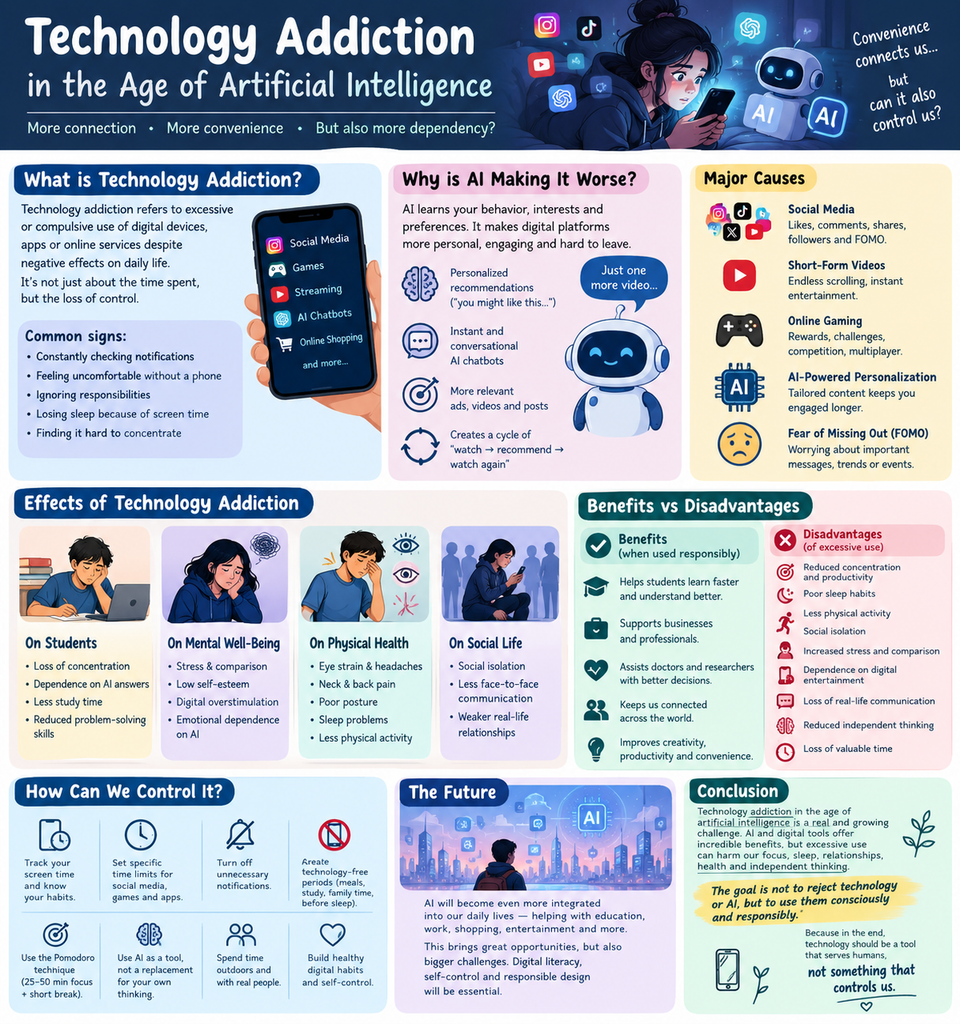
Technology Addiction in the Age of Artificial Intelligence
Technology has become an essential part of modern life. Smartphones, social media, online games, streaming platforms, computers, and artificial intelligence (AI) tools have changed the way people study, work, communicate, and entertain themselves. These technologies offer many benefits, but excessive and uncontrolled use can lead to technology addiction. In the age of artificial intelligence, this problem is becoming more complicated because AI can make digital platforms more personalized, engaging, and difficult to leave.
What Is Technology Addiction?
Technology addiction refers to excessive or compulsive use of digital devices, applications, or online services despite negative effects on daily life. A person may continuously check their phone, spend hours scrolling social media, play games for long periods, or depend heavily on AI tools.
Technology addiction does not always mean that a person uses technology for many hours. The important factor is loss of control. For example, someone may intend to use social media for ten minutes but continue for two hours. Similarly, a student may open an AI chatbot to complete one assignment but continue using it for entertainment, conversation, or unnecessary questions.
Common signs include constantly checking notifications, feeling uncomfortable without a phone, ignoring responsibilities, losing sleep because of screen use, and finding it difficult to concentrate without digital entertainment.
Why Is AI Making Technology More Addictive?
Artificial intelligence is changing digital experiences by learning about users’ interests and behaviors. Social media platforms can use AI-powered recommendation systems to suggest videos, posts, advertisements, and accounts that are likely to attract a person’s attention.
For example, if someone watches several short videos about fashion, an algorithm may continue recommending similar content. The user may keep scrolling because every new video is personally relevant. This creates a cycle of watching → recommendation → watching again.
AI chatbots also provide instant interaction. Unlike traditional software, AI systems can respond conversationally, answer questions, create stories, explain subjects, and sometimes remember context. This can make users spend more time interacting with technology.
Major Causes of Technology Addiction
1. Social Media
Social media is one of the biggest contributors to technology addiction. Likes, comments, shares, followers, and notifications can encourage people to repeatedly check their accounts. People may also compare their lives with others, creating a desire to stay constantly connected.
2. Short-Form Videos
Platforms offering short videos are designed to provide continuous entertainment. Since each video requires only a few seconds or minutes, users may keep scrolling without realizing how much time has passed.
3. Online Gaming
Online games use rewards, challenges, levels, achievements, and competition to keep players engaged. Multiplayer games can be particularly difficult to stop because players may feel responsible for their teammates.
4. AI-Powered Personalization
AI can analyze user behavior and provide highly personalized recommendations. While personalization can improve the user experience, it can also increase the amount of time people spend on digital platforms.
5. Fear of Missing Out
Many people worry that they might miss an important message, trend, news story, or social event. This feeling, often called FOMO (Fear of Missing Out), encourages frequent phone checking.
Effects on Students
Technology can be extremely useful for education. Students can use AI to understand difficult subjects, generate ideas, practice languages, summarize information, and improve their writing.
However, excessive dependence can create problems. Students may lose concentration, become dependent on AI-generated answers, or avoid developing their own problem-solving skills. Instead of thinking through a problem, they may immediately ask AI for the answer.
Excessive screen time can also reduce study time. A student may sit with a textbook or laptop but repeatedly switch to social media, videos, or games. This can reduce productivity and make studying more difficult.
Effects on Mental Well-Being
Excessive technology use may affect emotional well-being. Constant exposure to social media can lead to comparison, stress, and dissatisfaction. People may feel pressure to present a perfect version of themselves online.
Another problem is digital overstimulation. When people constantly receive notifications, videos, messages, and recommendations, their minds may have fewer opportunities to experience quiet and uninterrupted time.
Some people may also become emotionally dependent on AI chatbots or virtual assistants. AI can provide convenient conversation, but it cannot completely replace genuine human relationships and emotional support.
Effects on Physical Health
Technology addiction can also affect physical health. Spending long periods looking at screens may contribute to eye strain, headaches, neck discomfort, and poor posture.
Using smartphones late at night can also interfere with healthy sleep habits. A person may intend to check one notification before sleeping but end up scrolling for another hour.
Reduced physical activity is another concern. When entertainment is mainly digital, people may spend less time walking, exercising, playing sports, or participating in outdoor activities.
Benefits of Technology and AI
Technology addiction does not mean technology itself is bad. Technology has enormous advantages when used responsibly.
AI can help students learn faster and understand difficult concepts. Businesses can use AI for marketing, customer service, data analysis, and content creation. Doctors and researchers can use advanced technologies to analyze information and support decision-making. Communication technology allows people to stay connected across countries.
Therefore, the goal should not be to completely avoid technology. The goal is to develop healthy digital habits.
Disadvantages of Technology Addiction
Some major disadvantages include:
- Reduced concentration and productivity
- Poor sleep habits
- Less physical activity
- Social isolation
- Increased stress and comparison
- Dependence on digital entertainment
- Reduced face-to-face communication
- Difficulty completing tasks without checking devices
- Excessive dependence on AI for simple thinking and problem-solving
- Loss of valuable time
How Can We Control Technology Addiction?
The first step is to become aware of how much technology we actually use. Screen-time tracking tools can help people understand their daily habits.
Setting specific time limits can also be effective. For example, social media can be limited to a particular period each day.
Turning off unnecessary notifications is another simple solution. Notifications constantly encourage users to return to their devices.
People should also create technology-free periods, especially during meals, studying, family conversations, and before sleeping.
Students can use the Pomodoro technique, such as studying for 25–50 minutes without distractions followed by a short break.
Most importantly, AI should be treated as a tool, not a replacement for human thinking. Students should use AI to learn, brainstorm, and improve understanding rather than simply copying AI-generated answers.
The Future of Technology Addiction
As AI becomes more advanced, digital technology will become increasingly integrated into everyday life. AI assistants may help people with education, shopping, entertainment, communication, and work.
This creates both opportunities and challenges. Future technologies may become even better at predicting what users want and keeping them engaged. Therefore, digital literacy and self-control will become increasingly important.
Schools and families can help young people understand responsible technology use. Companies also have a responsibility to design platforms that consider user well-being rather than focusing only on maximum engagement.
Conclusion
Technology addiction in the age of artificial intelligence is an important challenge of modern society. AI and digital technologies provide enormous benefits, but excessive use can affect concentration, sleep, relationships, physical activity, and independent thinking.
The solution is not to reject technology or AI. Instead, people should learn to use them consciously and responsibly. Setting screen-time limits, taking regular breaks, protecting sleep, spending time with people offline, and maintaining independent thinking can help create a healthier relationship with technology.
Ultimately, technology should remain a tool that serves humans, rather than becoming something that controls human behavior. The future of AI will depend not only on how intelligent technology becomes, but also on how wisely people choose to use it.