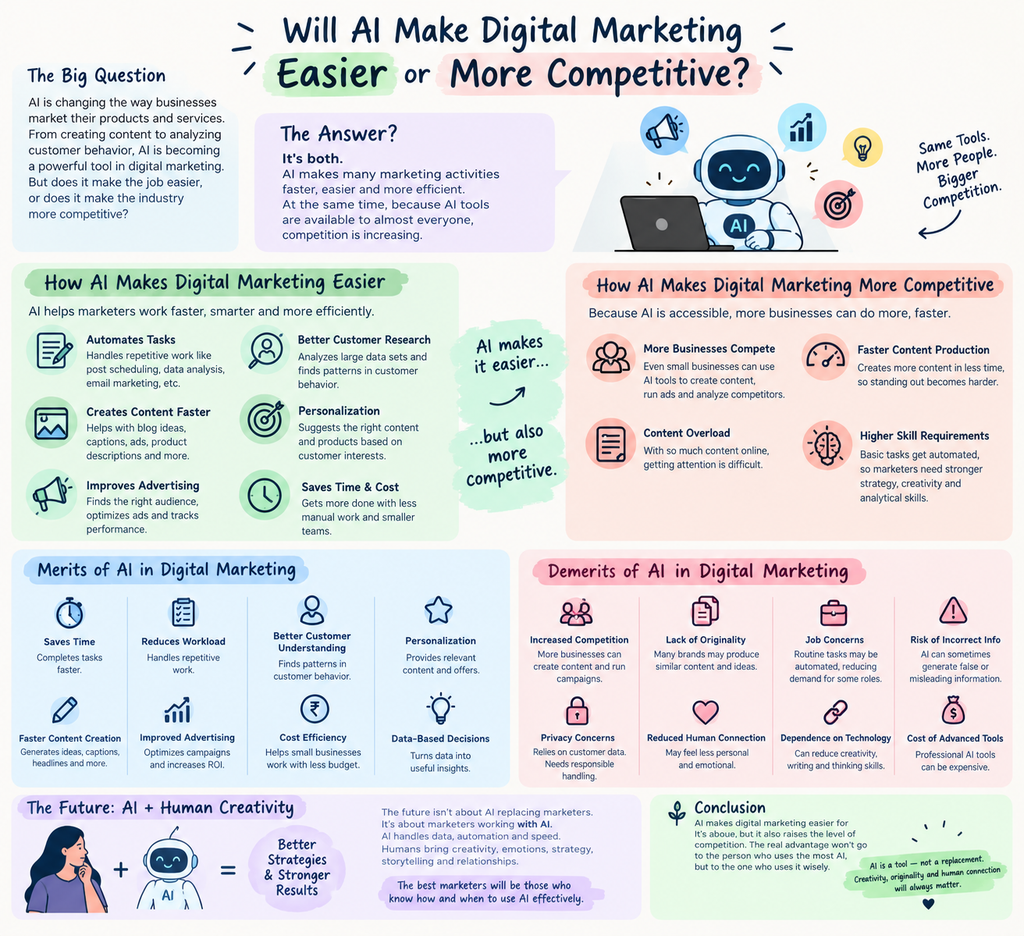
Artificial Intelligence (AI) is rapidly changing the way businesses operate, and digital marketing is one of the fields most affected by this technology. From creating social media posts to analyzing customer behavior, AI is becoming an important part of modern marketing. Businesses can now use AI tools to understand their audience, create content, automate tasks, and improve advertising campaigns. This raises an important question: Will AI make digital marketing easier, or will it make the industry more competitive?
The answer is that AI will do both. It can make many marketing activities faster, easier, and more efficient. At the same time, because AI tools are becoming available to almost everyone, competition is increasing. Marketers who know how to use AI effectively may have an advantage, while those who depend completely on AI without developing their own skills may struggle.
How AI Makes Digital Marketing Easier
One of the biggest benefits of AI is that it can automate repetitive marketing tasks. Digital marketers often spend a lot of time creating captions, writing emails, researching keywords, analyzing data, scheduling posts, and preparing advertisements. AI can help complete many of these tasks in a shorter period.
For example, AI writing tools can help marketers generate ideas for blogs, social media captions, advertisements, product descriptions, and email campaigns. Instead of starting from an empty page, marketers can use AI to create a first draft and then improve it using their own creativity and knowledge.
AI can also make customer research easier. Traditionally, marketers had to manually study large amounts of customer data to understand their audience. AI can analyze large datasets quickly and identify patterns in customer behavior. It can help businesses understand what customers are interested in, what products they prefer, and when they are most likely to make a purchase.
Another important area is personalization. Customers today expect businesses to provide relevant content. AI can analyze a customer’s previous searches, purchases, and interactions and help businesses provide personalized recommendations. For example, an online shopping website may recommend products based on a customer’s previous activity.
AI is also useful in advertising. It can help marketers identify suitable audiences, optimize advertisements, and analyze campaign performance. This can reduce wasted advertising budgets and help businesses achieve better results.
How AI Makes Digital Marketing More Competitive
Although AI makes marketing easier, it also increases competition. In the past, creating high-quality content or analyzing marketing data required specialized skills and considerable time. Today, AI tools can make many of these activities easier for almost anyone.
A small business owner can use AI to create social media content, generate advertisement ideas, analyze competitors, and plan campaigns without having a large marketing team. This means more businesses can compete in the digital marketplace.
AI also increases the speed of content production. A marketer who previously created five social media posts in a day may now be able to create many more with the help of AI. As a result, the amount of content available online continues to increase. Because there is so much content, getting attention from customers becomes more difficult.
This means that simply producing content is no longer enough. Marketers need to create content that is useful, original, interesting, and relevant to their target audience.
AI may also change the skills employers expect from digital marketers. Basic tasks such as writing simple captions, generating ideas, or preparing reports may become increasingly automated. Therefore, marketers may need stronger skills in strategy, creativity, communication, critical thinking, branding, data interpretation, and customer understanding.
Merits of AI in Digital Marketing
1. Saves Time
AI can automate repetitive tasks and help marketers complete work faster. This gives marketers more time to focus on strategy and creative activities.
2. Reduces Workload
AI can assist with content creation, data analysis, customer support, email marketing, and advertising. This can reduce the amount of manual work required.
3. Better Customer Understanding
AI can analyze customer data and identify patterns. This helps marketers understand customer interests, preferences, and behavior.
4. Personalization
AI can help businesses provide personalized recommendations and messages. Customers are more likely to engage with content that is relevant to their interests.
5. Faster Content Creation
Marketers can use AI to generate content ideas, captions, headlines, scripts, and other marketing materials quickly.
6. Improved Advertising
AI can help analyze advertising performance and identify which audiences and messages are producing better results. This can improve marketing efficiency.
7. Cost Efficiency
Small businesses can use AI tools to perform certain marketing tasks without needing a large team. This can reduce some operational costs.
8. Data-Based Decision Making
AI can process large amounts of information quickly. Marketers can use these insights to make more informed decisions instead of relying only on assumptions.
Demerits of AI in Digital Marketing
1. Increased Competition
Because AI tools are widely available, more businesses can create content and run digital campaigns. This makes it harder for individual brands to stand out.
2. Lack of Originality
If marketers depend too much on AI-generated content, many brands may produce similar posts, advertisements, and ideas. This can make marketing content feel repetitive.
3. Job Concerns
Some routine marketing tasks may become automated. This can reduce the demand for certain entry-level or repetitive roles and force marketers to develop new skills.
4. Risk of Incorrect Information
AI can sometimes generate inaccurate or misleading information. Therefore, marketers must review and fact-check AI-generated content before publishing it.
5. Privacy Concerns
AI-powered marketing often depends on customer data. Businesses must handle personal information responsibly and follow applicable privacy and data-protection requirements.
6. Reduced Human Connection
Marketing is not only about data. Human emotions, culture, humor, trust, and relationships are also important. Overusing AI can make communication feel less personal.
7. Dependence on Technology
If marketers rely completely on AI, they may lose opportunities to develop their own creativity, writing ability, analytical thinking, and strategic skills.
8. Cost of Advanced AI Tools
Although many AI tools are affordable or free, advanced systems and professional AI solutions can be expensive for some businesses.
The Future of AI and Digital Marketing
The future of digital marketing will probably not be about AI replacing marketers completely. Instead, it will be about marketers working together with AI.
AI is very good at processing information, identifying patterns, automating repetitive tasks, and generating ideas. Humans, however, are still important for creativity, emotional understanding, strategic thinking, ethical decisions, storytelling, and building relationships with customers.
For example, a marketer can ask AI to analyze customer data and suggest campaign ideas. The marketer can then use personal experience and creative thinking to choose the best idea and develop it into an effective campaign.
Therefore, the most successful digital marketers in the future may be those who can combine AI skills with human creativity.
Conclusion
AI is making digital marketing both easier and more competitive. It makes marketing easier by saving time, reducing repetitive work, analyzing data, personalizing customer experiences, and supporting content creation. At the same time, it makes the industry more competitive because almost every business can access similar AI tools.
The biggest advantage will not necessarily go to the person who uses the most AI. Instead, it will go to the marketer who knows how and when to use AI effectively.
AI should be viewed as a tool rather than a complete replacement for human marketers. Human creativity, originality, emotional intelligence, and strategic thinking remain essential. Digital marketers who learn to use AI while maintaining their own unique ideas and skills will be better prepared for the future.
In conclusion, AI will make digital marketing easier for everyone, but it will also raise the level of competition for everyone. The future belongs to marketers who can combine technology with creativity and use AI intelligently rather than depending on it completely.
The short answer is both. AI will make the execution of digital marketing significantly easier, but it will simultaneously make the landscape fiercely competitive.
While AI democratizes content creation and data analysis, it removes the barrier to entry. This means everyone can now produce high-quality content at scale, leading to a crowded digital marketplace where standing out requires more strategy than ever before.
🛠️ Why AI Makes Digital Marketing Easier
AI acts as a massive force multiplier for daily marketing operations, saving time and automating tedious tasks.
- Content Generation at Scale: Tools can draft blogs, social media posts, and ad copy in seconds. Ideation and scripting that used to take days now take minutes.
- Hyper-Personalization: AI algorithms analyze user behavior in real-time. This allows brands to serve highly tailored product recommendations and email campaigns automatically.
- Data Synthesis: Instead of spending hours digging through Google Analytics, AI can instantly spot trends, predict churn, and highlight which ad creatives are performing best.
- Streamlined Operations: Chatbots handle first-line customer service, while automated bidding tools optimize ad spend across platforms like Google and Meta around the clock.
🤼 Why AI Makes Digital Marketing More Competitive
When everyone has access to a supercomputer in their pocket, the baseline standard for “good marketing” rises.
- The Content Deluge: Because creating content is now easy, the internet is being flooded with AI-generated blogs, videos, and graphics. Breaking through this “noise” to reach consumers is harder than ever.
- Ad Fatigue & Rising Costs: As more businesses use automated ad tools, competition in ad auctions is skyrocketing. This drives up Cost-Per-Click (CPC) and makes organic reach even scarcer.
- Disruption of Search (GEO vs. SEO): With search engines shifting toward AI-driven answers (like Google’s AI Overviews), users get answers directly on the search results page. This reduces traditional organic clicks to websites.
- Loss of the “Human Moat”: Generic AI content looks and feels the same. Brands that rely solely on automated outputs will suffer from creative stagnation and lose customer trust.
📊 Direct Comparison: The Shift in Roles
| Marketing Function | How it used to be (Pre-AI) | How it is now (With AI) | The New Competitive Edge |
|---|---|---|---|
| SEO & Content | Writing 1,000-word articles based on keyword density. | Generating 10 articles in minutes using prompts. | EEAT: Original research, unique thought leadership, and human interviews. |
| Paid Ads | Manually tweaking bids, keywords, and audience targeting. | Algorithmic bidding and automated creative testing. | Creative Strategy: High-quality video hooks, psychological angles, and brand storytelling. |
| Data & Analytics | Manually building spreadsheets and pivoting tables. | AI dashboards predicting consumer trends instantly. | Execution Speed: How fast a brand can pivot budgets based on AI insights. |
💡 The Verdict: How to Win
AI is shifting the value of digital marketing away from production and moving it entirely toward strategy, taste, and authenticity.
To survive the competitive surge, marketers must focus on what AI cannot replicate: true human connection, proprietary data, community building, and unique brand voice. AI will do the heavy lifting, but humans must still steer the ship.
To help tailor this to your goals, are you looking at this from the perspective of a business owner trying to scale your marketing, or a digital marketer looking to upskill and secure your career?
AI can make mistakes, so double-check responses
Benefits of New-Generation AI in Digital Marketing
- Faster Content Creation
New-generation AI can quickly create captions, blogs, advertisements, video scripts, product descriptions, and social media ideas. This saves marketers a lot of time. - Better Personalization
AI can understand customer interests and behavior. It can help businesses show different content and product recommendations to different customers. - Smarter Customer Targeting
AI can analyze customer data and identify the people who are most likely to be interested in a product or service. This helps marketers reach the right audience. - 24/7 Customer Support
AI chatbots can answer customer questions at any time. Customers do not always have to wait for a human employee to respond. - Improved Advertising
AI can analyze which advertisements perform well and help marketers improve their campaigns. This can reduce wasted advertising spending. - Better Data Analysis
Modern AI can process huge amounts of marketing data much faster than humans. It can identify trends, customer preferences, and campaign performance. - Automation of Repetitive Tasks
Tasks such as email marketing, social media scheduling, customer responses, and basic reporting can be automated. Marketers can then focus on more creative and strategic work. - Better Customer Experience
AI can provide personalized recommendations, faster responses, and relevant content. This can make the customer experience more convenient. - Helps Small Businesses
New-generation AI gives small businesses access to tools that were previously available mainly to large companies. A small business can use AI for content, advertising, research, and customer support without needing a huge marketing team. - More Creativity and Ideas
AI can generate different campaign concepts, headlines, designs, video ideas, and content strategies. Marketers can use these ideas as a starting point and add their own creativity.
In short 🌟
New-generation AI makes digital marketing faster, smarter, more personalized, and more efficient. However, AI should be used as a supporting tool, not a complete replacement for human creativity and strategy. The best results come when AI technology + human creativity work together.