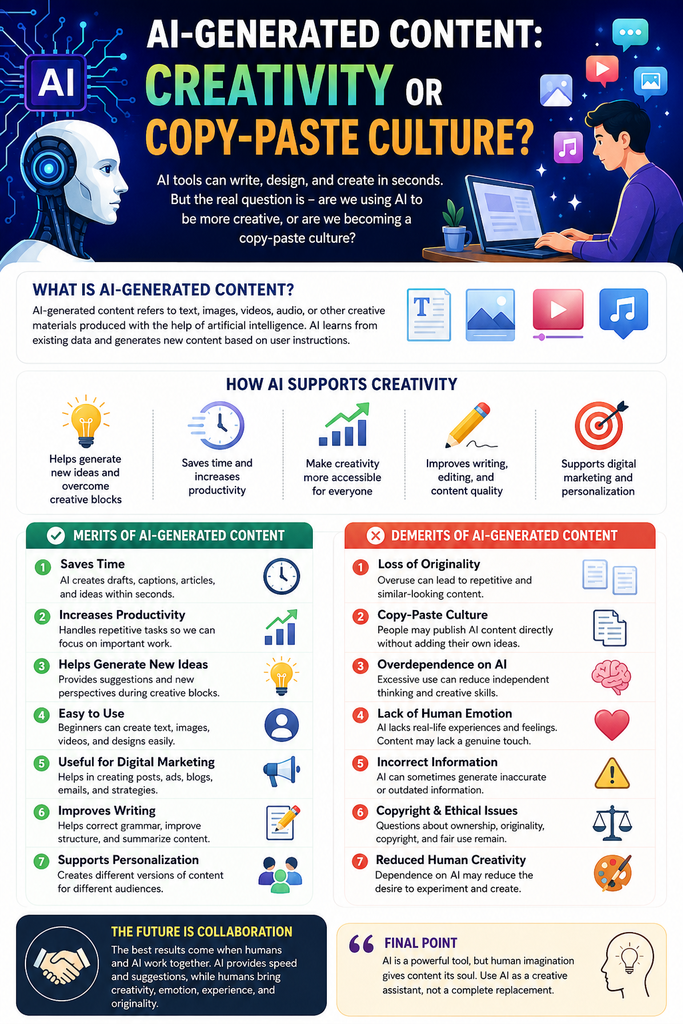
Artificial Intelligence (AI) has changed the way people create and consume content. Today, AI tools can write articles, create social media captions, generate images, make videos, compose music, and even help develop ideas within seconds. What once required hours or days of human effort can now be completed much faster. Because of this, AI-generated content has become common in digital marketing, education, entertainment, business, and social media.
However, an important question has emerged: Is AI-generated content a new form of creativity, or is it creating a copy-paste culture where people depend too much on machines? The answer is not completely simple. AI can support creativity, but excessive dependence on it can also reduce originality and human thinking.
What Is AI-Generated Content?
AI-generated content refers to text, images, videos, audio, designs, or other creative materials produced with the help of artificial intelligence. AI systems learn from large amounts of existing information and use patterns from that information to generate new content based on a user’s instructions.
For example, a digital marketer can ask an AI tool to create an Instagram caption for a product. A student can use AI to understand a difficult topic. A designer can use AI to generate an image based on a description. A business can use AI to create advertising ideas or product descriptions.
AI does not simply work like a traditional copy-and-paste tool. It can generate new combinations of words, ideas, styles, and visual elements. However, because AI learns from existing human-created material, questions about originality, ownership, and creativity remain important.
AI as a Tool for Creativity
One of the biggest advantages of AI is that it can support human creativity. Creativity often begins with an idea, but people may struggle to turn that idea into something complete. AI can help with brainstorming, writing, designing, editing, and improving content.
For example, someone may have an idea for a YouTube video but not know how to structure it. AI can suggest a title, introduction, points to discuss, and a conclusion. The creator can then modify these suggestions and add personal experiences.
AI can also help people overcome creative blocks. A writer who cannot think of a suitable opening can ask AI for several possibilities. A designer can generate different visual concepts before choosing one and developing it further.
In this way, AI can work like a creative assistant rather than a replacement for the creator.
AI Makes Content Creation Faster
Another major benefit is speed. Creating quality content traditionally takes considerable time. Researching a topic, writing a draft, correcting grammar, creating visuals, and editing can take hours.
AI can reduce this workload significantly. A digital marketer, for example, may need multiple social media posts every week. AI can help generate initial ideas, captions, hashtags, content calendars, and advertising concepts.
This allows creators to spend more time on strategy and creative decision-making rather than repetitive tasks.
AI Makes Creativity More Accessible
Previously, professional creative work often required specialized skills. Someone who wanted to design a poster might need graphic design knowledge. Someone who wanted to create a video might need video-editing skills.
AI tools are making some of these creative activities easier for beginners. A person can describe what they want and receive an initial result without having advanced technical skills.
This can encourage more people to experiment with writing, photography, design, marketing, and storytelling.
The Copy-Paste Culture Problem
Despite these advantages, AI can also create a copy-paste culture.
If people simply generate content with AI and publish it without reviewing or changing it, the internet can become filled with similar-looking and similar-sounding content. Many AI-generated articles may follow the same structures, use predictable phrases, and provide generic explanations.
For example, if thousands of businesses ask AI to create a caption for the same type of product, many captions may sound almost identical. Instead of developing a unique brand voice, businesses may simply copy AI-generated suggestions.
This can make online content feel repetitive and less personal.
Loss of Original Thinking
Another concern is that excessive AI dependence may affect people’s ability to think independently.
If students use AI to answer every question without trying to understand the topic, they may miss opportunities to develop research, writing, problem-solving, and critical-thinking skills.
Similarly, if content creators depend on AI for every idea, they may gradually stop experimenting with their own creative concepts.
The purpose of technology should be to strengthen human abilities, not completely replace them.
Lack of Personal Experience
Human creativity is strongly connected to personal experiences, emotions, memories, culture, and relationships. AI can generate impressive content, but it does not live a human life or experience emotions in the same way humans do.
A person writing about friendship can include memories from their own life. A photographer can capture a meaningful moment that they personally experienced. A filmmaker can tell a story influenced by their culture and emotions.
These personal elements can make content unique.
AI can help express such ideas, but the human creator needs to provide the experience and meaning behind them.
Ethical and Copyright Concerns
AI-generated content also raises ethical questions. AI models are trained using enormous amounts of information, much of which originates from human-created work. This creates ongoing debates about copyright, ownership, consent, and fair compensation.
There are also concerns about AI-generated images and videos being presented as real. Deepfakes and manipulated content can make it difficult for people to know what is authentic.
Therefore, creators have a responsibility to use AI honestly and carefully.
Advantages of AI-Generated Content
1. Saves time: AI can quickly generate drafts, ideas, and basic content.
2. Encourages creativity: It can provide new ideas when people experience creative blocks.
3. Easy for beginners: People without advanced technical skills can create content with AI assistance.
4. Supports digital marketing: AI can help marketers create captions, advertisements, blogs, emails, and content plans.
5. Improves productivity: Repetitive tasks can be automated, allowing people to focus on more important work.
6. Supports personalization: AI can help create content for different audiences and platforms.
Disadvantages of AI-Generated Content
1. Reduced originality: Overuse can result in repetitive and predictable content.
2. Copy-paste culture: People may publish AI-generated material without adding their own ideas.
3. Dependence on technology: Excessive use may weaken independent thinking and creative skills.
4. Misinformation: AI can sometimes generate incorrect or misleading information.
5. Ethical concerns: Questions about copyright, ownership, and responsible use remain important.
6. Loss of human touch: Content created entirely by AI may lack personal emotions, experiences, and authentic perspectives.
The Future of AI and Creativity
The future will probably not be about choosing between humans and AI. Instead, it will involve humans working together with AI.
The most successful creators may be those who know how to use AI while still maintaining their own identity and ideas. AI can handle repetitive tasks and provide suggestions, while humans can provide creativity, emotion, judgment, experience, and originality.
For example, a digital marketer could use AI to generate ten campaign ideas but personally select the best one, research the audience, add a unique brand message, create original visuals, and check the information before publishing it.
This approach keeps humans at the center of the creative process.
Conclusion
AI-generated content is neither completely creativity nor simply copy-paste culture. It depends on how people use it.
When AI is used as a tool for brainstorming, improving, experimenting, and saving time, it can increase creativity and productivity. But when people blindly copy AI-generated content without adding their own ideas, it can lead to repetitive content and a loss of originality.
The real value of AI is not that it can create content quickly. Its greatest value is that it can help humans turn their ideas into reality more efficiently.
Therefore, the future of content creation should not be “AI instead of humans.” It should be “AI with humans.” Technology can provide the tools, but human imagination, emotion, experience, and originality are what give content its true meaning.
erits of AI-Generated Content
- Saves Time – AI can create drafts, captions, articles, and ideas within seconds, reducing the time needed for content creation.
- Increases Productivity – Creators can use AI for repetitive tasks and spend more time on important creative and strategic work.
- Helps Generate New Ideas – AI can provide different ideas and suggestions when a person is experiencing a creative block.
- Easy to Use – Even beginners can create basic text, images, videos, and designs with AI tools without having advanced technical skills.
- Useful for Digital Marketing – AI can help marketers create social media posts, advertisements, blog topics, email content, and marketing strategies.
- Improves Writing – AI can help correct grammar, improve sentence structure, summarize information, and make writing clearer.
- Supports Personalization – AI can help create different versions of content for different audiences, platforms, and customer groups.
Demerits of AI-Generated Content
- Loss of Originality – If everyone uses AI in the same way, online content can become repetitive and similar.
- Copy-Paste Culture – Some people may publish AI-generated content directly without adding their own thoughts, experiences, or creativity.
- Overdependence on AI – Excessive use of AI can reduce independent thinking, writing skills, and problem-solving abilities.
- Lack of Human Emotion – AI can produce emotional-sounding content, but it does not have human experiences and feelings. Completely AI-created content may therefore lack a genuine personal touch.
- Possibility of Incorrect Information – AI can sometimes generate inaccurate or outdated information, so users should verify important facts.
- Copyright and Ethical Issues – AI-generated content raises questions about ownership, originality, copyright, and the use of existing creative work.
- Reduced Human Creativity – When people depend on AI for every idea, they may become less willing to experiment and develop their own creative abilities.
Final Point
AI is most useful when it acts as a creative assistant, not as a complete replacement for human creativity. The best content combines AI’s speed and efficiency with human ideas, emotions, experience, and originality.
Available next action: Create a downloadable DOCX file here in this chat containing the editable prose above
I-Generated Content: Creativity or Copy-Paste Culture?
The rise of generative artificial intelligence has sparked a fierce global debate: Is AI a revolutionary catalyst for human creativity, or is it merely a sophisticated engine driving a glorified copy-paste culture? Platforms capable of generating essays, art, and music in seconds have completely transformed how we create and consume information.
However, beneath the polished prose and hyper-realistic images lies a complex technological paradox. While AI democratizes creation by lowering technical barriers, its reliance on pre-existing data threatens to homogenize culture and normalize intellectual laziness. Understanding the future of expression requires exploring both the creative breakthroughs and the derivative pitfalls of AI-generated content.
The Technology: Recomposition vs. Raw Creation
To evaluate whether AI is truly creative, we must first look at how it operates. AI models do not possess a conscious mind, nor do they experience feelings, flashes of sudden inspiration, or real-world events. Instead, systems like large language models (LLMs) and diffusion models are trained on massive datasets of human-created text, code, and imagery.
[Human Prompt]
       │
       ▼
┌────────────────────────────────────────────────────────┐
│               Generative AI Architecture               │
│                                                        │
│  1. Tokenizes input and analyzes contextual intent      │
│  2. Evaluates statistical patterns from training data  │
│  3. Synthesizes and predicts the next probable sequence │
└────────────────────────────────────────────────────────┘
       │
       ▼
[Predictive Mathematical Output]
When a user feeds a prompt into an AI, the algorithm calculates statistical probabilities based on its training to predict the next word or pixel. According to documentation by tech leaders like IBM, this process is fundamentally reconstructive and transformative rather than originating. The machine pieces together bits of learned information to output something seemingly new. Because it relies entirely on mathematical relationships rather than real personal insight, the foundational mechanism leans closer to highly advanced data recombination than conscious artistry.
The Case for Creativity: Democratization and Cognitive Spark
Proponents argue that generative AI is a powerful collaborative partner that expands the boundaries of human imagination. In this light, AI functions less like a plagiarist and more like a cognitive springboard.
1. Eliminating Technical Barriers
Historically, expressing a profound concept required years of mastery over specific tools, such as oil paints, editing software, or complex musical instruments. Generative AI shifts the focus from mechanical execution to ideation. An individual with a brilliant cinematic concept but no animation skills can now use text-to-video tools to draft a visual storyboard. This democratizes the creative landscape, allowing people to focus entirely on the core narrative and creative direction.
2. Overcoming the “Cold Start” Problem
Writer’s block and creative stagnation are major hurdles for creators. AI functions as an always-on assistant capable of generating dozens of conceptual outlines, content variations, or headlines instantly. As highlighted in a study published on ScienceDirect, students utilizing generative tools found that unexpected AI outputs sparked new analytical directions they hadn’t initially considered.
3. Cross-Disciplinary Synthesis
By blending disparate concepts from its training data, AI can produce surprising, surreal, and novel combinations. It can effortlessly write a poem about quantum physics in the stylistic tone of a 16th-century sonnet. This rapid cross-pollination of genres can inspire human artists to explore entirely new aesthetic territories.
The Case for Copy-Paste Culture: Plagiarism and Homogenization
Conversely, critics suggest that an over-reliance on AI encourages a lazy “copy-paste” mindset, devaluing deep intellectual thought and genuine originality.
| Creative Threat | Impact on Content Ecosystem |
|---|---|
| Statistical Regression | Algorithms prioritize highly repetitive, safe patterns based on past viral success, which actively suppresses unconventional thinking. |
| Normalizing Plagiarism | Users frequently publish raw machine outputs that closely mimic copyrighted material without realizing it. |
| The “Slop” Phenomenon | Digital channels face an influx of low-effort, formulaic articles and imagery optimized solely to rank on search engines. |
1. Intellectual Stagnation and “AI Simulacra”
When software handles the heavy lifting of drafting, outlining, and structuring, human creators risk losing their analytical edge. Academic research from platforms like ResearchGate warns of a growing “culture of instantaneousness”. This mindset prioritizes speed of output over deep intellectual refinement, resulting in an influx of formal but empty text structures that look scientific but lack real substance.
2. Fixation Bias and Monoculture
AI models suffer heavily from fixation bias. Experiments measuring creative output show that tools like ChatGPT excel at sheer volume, yet their concepts consistently fall within highly conventional categories. Because they are trained on existing web data, their outputs mirror the statistical average of what already exists. If the internet becomes flooded with AI content, future models will be trained on old AI data, creating a feedback loop that homogenizes art, journalism, and design into a bland, repetitive monoculture.
3. Ethics and the Loss of Meaning
Because the system reconfigures protected works behind closed doors, it blurs the ethical boundaries of fair use. Furthermore, audiences naturally seek out the human struggle behind art. As explored in essays on Aeon, machine writing can never replicate authentic personal memory or lived human experiences. When audiences discover a piece is completely AI-generated, they often devalue its worth, viewing it as a product of minimal effort rather than genuine inspiration.
The Path Forward: The “Cyborg” Collaboration
The debate should not center on replacing humans with AI, but rather on how humans can responsibly collaborate with it. Purely copying and pasting raw AI output results in derivative, stale work that fails to connect with audiences. Truly innovative creators use a hybrid co-creative workflow instead:
┌─────────────────┐       ┌─────────────────┐       ┌─────────────────┐
│  Human Phase 1  │──────>│    AI Phase     │──────>│  Human Phase 2  │
│  Core Concept   │       │  Bulk Drafting  │       │  Critical Lens  │
│  & Unique Angle │       │   & Ideation    │       │ & Voice Editing │
└─────────────────┘       └─────────────────┘       └─────────────────┘
In this balanced paradigm, the machine handles initial time-consuming drafts, structural organization, and data analysis. The human creator then steps back in to provide the critical perspective, emotional depth, humor, and unique personal storytelling that an algorithm cannot replicate.
Conclusion
Ultimately, generative AI itself is neither purely creative nor just a basic copy-paste tool. It acts as a mirror for the user’s intent. Prompting a tool to write an entire article and publishing it verbatim reflects a lazy, derivative copy-paste culture. However, utilizing it to break through creative ruts, synthesize complex ideas, and iterate on concepts serves as a powerful engine for innovation. True creativity does not come from outsourcing the entire cognitive process; it emerges when human intuition guides machine efficiency to build something entirely new.
If you want to explore specific dimensions of this topic further, let me know:
- Should we focus on the legal copyright battles between artists and AI tech firms?
- Would you like to look at AI’s impact on a specific field like journalism, screenwriting, or video games?
- Should we dive into practical strategies for maintaining your distinct voice while using AI?
Capitol Technology UniversityIs AI Good or Bad for Creativity: How Generative AI is …10 Dec 2025 — Despite its benefits, AI poses real risks to human creativity. Because AI lacks intuition and emotion, over-reliance on AI can lea…
VtigerWhat Is AI-Generated Content? How It Works and Why It Matters11 Nov 2024 — How AI-Generated Content Works. AI-generated content works by training machine learning models on large volumes of human-created d…
MediumAI-Generated Content vs. Human Creativity: Where Do We Draw the Line?11 Feb 2025 — AI can be a powerful tool in a creative process, but it shouldn’t be the whole process. AI can: * Remix, rephrase, and reformat * …
Show all